
Skip to content
Free Excel Tutorials
  • Home
  • Excel For Beginners
  • Excel Intermediate
  • Advanced Excel For Experts

Data Analysis

  • How to combine 2 or more chart types in a single chart in Excel
  • How to Create Area Chart in Excel
  • How to calculate correlation coefficient Correlation in Excel
  • Add Outline to Data in Excel
  • Use Data Form to input, edit and delete records in Excel

References

  • How to get address of named range in Excel
  • Perform case-sensitive Lookup in Excel
  • Lookup entire row in Excel
  • How to get last row in numeric data in Excel
  • Left Lookup in Excel

Data Validations

  • Excel Data validation no punctuation
  • Excel Data validation allow uppercase only
  • Excel Data validation must begin with
  • Data validation must not exist in list
  • Excel Data validation date in next 30 days

How to extract last two words from text string in Excel

by

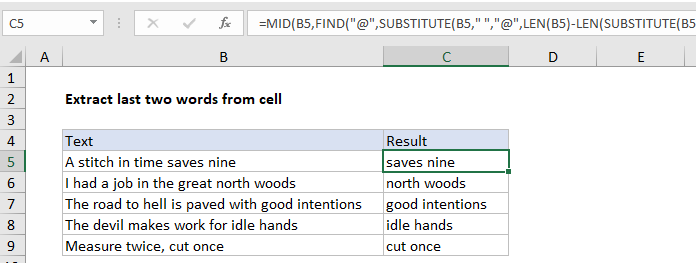
To extract the last two words from a cell, you can use a formula built with several Excel functions, including MID, FIND, SUBSTITUTE, and LEN.

Formula

=MID(A1,FIND("@",SUBSTITUTE(A1," ","@",LEN(A1)-LEN(SUBSTITUTE(A1," ",""))-1))+1,100)
Explanation

In the example shown, the formula in C5 is:

=MID(B5,FIND("@",SUBSTITUTE(B5," ","@",LEN(B5)-LEN(SUBSTITUTE(B5," ",""))-1))+1,100)

How this formula works

At the core, this formula uses the MID function to extract characters starting at the second to last space.  The MID function takes 3 arguments: the text to work with, the starting position, and the number of characters to extract.

The text comes from column B, and the number of characters can be any large number that will ensure the last two words are extracted. The challenge is to determine the starting position, which is just after the second to last space. The clever work is done primarily with the SUBSTITUTE function, which has an optional argument called instance number.  This feature is used to replace the second to last space in the text with the “@” character, which is then located with the FIND function.

Working from the inside out, the snippet below figures out how many spaces are in the text total, from which 1 is subtracted.

LEN(B5)-LEN(SUBSTITUTE(B5," ",""))-1

In the example shown, there are 5 spaces in the text, so the code above returns 4. This number is fed into the outer SUBSTITUTE function as instance number:

SUBSTITUTE(B5," ","@",4)

This causes SUBSTITUTE to replace the forth space character with “@”. The choice of @ is arbitrary. You can use any character that will not appear in the original text.

Next, the FIND locates the “@” character in the text:

FIND("@","A stitch in time@saves nine")

The result of FIND is 17, to which 1 is added to get 18. This is the starting position, and goes into the MID function as the second argument. For simplicity, the number of characters to extract is hardcoded as 100. This number is arbitrary and can be adjusted to fit the situation.

Extract last N words from cell

This formula can be generalized to extract the last N words from a cell by replacing the hardcoded 1 in the example with (N-1). In addition, if you are extracting many words, you may want to replace the hardcoded argument in MID, 100, with a larger number. To guarantee you the number is large enough, you could simply use the LEN function as follows:

=MID(B5,FIND("@",SUBSTITUTE(B5," ","@",LEN(B5)-LEN(SUBSTITUTE(B5," ",""))-(N-1)))+1,LEN(B5))

Post navigation

Next Post:

Create One-dimensional and Two-dimensional Array

Leave a Reply Cancel reply

Your email address will not be published. Required fields are marked *

Learn Basic Excel

Ribbon
Workbook
Worksheets
Format Cells
Find & Select
Sort & Filter
Templates
Print
Share
Protect
Keyboard Shortcuts

Categories

  • Charts
  • Data Analysis
  • Data Validation
  • Excel Functions
    • Cube Functions
    • Database Functions
    • Date and Time Functions
    • Engineering Functions
    • Financial Functions
    • Information Functions
    • Logical Functions
    • Lookup and Reference Functions
    • Math and Trig Functions
    • Statistical Functions
    • Text Functions
    • Web Functions
  • Excel VBA
  • Excel Video Tutorials
  • Formatting
  • Grouping
  • Others

Logical Functions

  • IFS function: Description, Usage, Syntax, Examples and Explanation
  • How to use Excel FALSE Function
  • IF function: Description, Usage, Syntax, Examples and Explanation
  • Not Equal To ‘<>‘ operator in Excel
  • TRUE function: Description, Usage, Syntax, Examples and Explanation

Date Time

  • Get work hours between dates and times in Excel
  • Get first day of previous month in Excel
  • Series of dates by day
  • Get days, hours, and minutes between dates in Excel
  • Display Date is same month in Excel

Grouping

  • How to randomly assign people to groups in Excel
  • Categorize text with keywords in Excel
  • Group numbers at uneven intervals in Excel
  • If cell contains one of many things in Excel
  • Group times into unequal buckets in Excel

General

  • How to calculate decrease by percentage in Excel
  • Find, Trace and Correct Errors in Excel Formulas using ‘Formula Auditing’
  • Excel Ribbon Quick Overview For Beginners
  • Share Excel data with Word documents
  • Select, Insert, Rename, Move, Delete Worksheets in Excel
© 2026 xlsoffice . All Right Reserved. | Teal Smiles | Abbreviations And Their Meaning