
Skip to content
Free Excel Tutorials
  • Home
  • Excel For Beginners
  • Excel Intermediate
  • Advanced Excel For Experts

Data Analysis

  • Data Series in Excel
  • How to count table columns in Excel
  • Conditional Formatting New Rule with Formulas in Excel
  • Excel Bar Chart
  • Excel Frequency Function Example

References

  • Extract data with helper column in Excel
  • Multi-criteria lookup and transpose in Excel
  • Complete List of Excel Lookup and Reference Functions, References and Examples
  • Extract all partial matches in Excel
  • How to get last row in numeric data in Excel

Data Validations

  • How To Create Drop-down List in Excel
  • Excel Data validation specific characters only
  • Excel Data validation exists in list
  • Data validation must not exist in list
  • Excel Data validation must not contain

Group times into 3 hour buckets in Excel

by

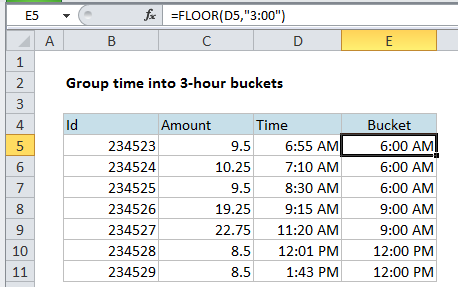
This tutorial shows how to Group times into 3 hour buckets in Excel using the example below;

Formula

=FLOOR(time,"3:00")
Explanation

If you need to group times into buckets (i.e. group by 2 hours, group by 3 hours, etc.) you can do so with a rounding function called FLOOR.

In the example shown, we have a number of transactions, each with a time stamp. Let’s say you want to group these transactions into buckets of 3 hours.

That means you would ultimately have buckets like the following:

12:00 AM-3:00 AM
3:00 AM-6:00 AM
6:00 AM-9:00 AM
9:00 AM-12:00 PM

So, for example, a time of 2:30 AM, needs to go into the 12:00 AM – 3:00 AM bucket. A time of 8:45 AM needs to go into the 6:00 AM-9:00 AM bucket, and so on.

If you think about it, one way to do this is to round each time until it fits into the right bucket. However, unlike normal rounding, where we might round to the nearest multiple, in this case, we want to round down to the nearest multiple, starting at midnight.

Because times are just decimal numbers, you can easily do this with the FLOOR function, which rounds down to a multiple that you supply (FLOOR calls the argument that represents multiple “significance”). Even better, FLOOR understands how to round time.

In the example shown, the formula in E5 is:

=FLOOR(D5,"3:00")

FLOOR knows how to read time, so it interprets 3:00 as it’s decimal equivalent, 0.125. It then simple rounds down each time to the nearest multiple of 0.125

You can use this same approach to group times into any standard bucket that you like.

Post navigation

Previous Post:

COSH function: Description, Usage, Syntax, Examples and Explanation

Next Post:

Excel Data validation require unique number

Leave a Reply Cancel reply

Your email address will not be published. Required fields are marked *

Learn Basic Excel

Ribbon
Workbook
Worksheets
Format Cells
Find & Select
Sort & Filter
Templates
Print
Share
Protect
Keyboard Shortcuts

Categories

  • Charts
  • Data Analysis
  • Data Validation
  • Excel Functions
    • Cube Functions
    • Database Functions
    • Date and Time Functions
    • Engineering Functions
    • Financial Functions
    • Information Functions
    • Logical Functions
    • Lookup and Reference Functions
    • Math and Trig Functions
    • Statistical Functions
    • Text Functions
    • Web Functions
  • Excel VBA
  • Excel Video Tutorials
  • Formatting
  • Grouping
  • Others

Logical Functions

  • Invoice status with nested if in Excel
  • TRUE function: Description, Usage, Syntax, Examples and Explanation
  • How to return blank in place of #DIV/0! error in Excel
  • Not Equal To ‘<>‘ operator in Excel
  • Check multiple cells are equal in Excel

Date Time

  • Add days to date in Excel
  • Get day name from date in Excel
  • NETWORKDAYS.INTL function: Description, Usage, Syntax, Examples and Explanation
  • Get month from date in Excel
  • Convert Excel time to Unix time in Excel

Grouping

  • Group times into 3 hour buckets in Excel
  • Map inputs to arbitrary values in Excel
  • Group arbitrary text values in Excel
  • How to randomly assign people to groups in Excel
  • Map text to numbers in Excel

General

  • Common Errors in Excel
  • AutoRecover file that was never saved in Excel
  • Basic numeric sort formula in Excel
  • 3D SUMIF for multiple worksheets in Excel
  • How to choose page/paper size in Excel before Printing
© 2026 xlsoffice . All Right Reserved. | Teal Smiles | Abbreviations And Their Meaning