
Skip to content
Free Excel Tutorials
  • Home
  • Excel For Beginners
  • Excel Intermediate
  • Advanced Excel For Experts

Data Analysis

  • How to add Trendline to a chart in Excel
  • Conditional Formatting New Rule with Formulas in Excel
  • Calculate Conditional Percentile ‘IF’ in table in Excel
  • How to Create Thermometer Chart in Excel
  • How to create a Histogram in Excel

References

  • How to use Excel INDIRECT Function
  • Left Lookup in Excel
  • Convert text string to valid reference in Excel using Indirect function
  • Perform case-sensitive Lookup in Excel
  • How to use Excel ROW Function

Data Validations

  • Excel Data validation don’t exceed total
  • Excel Data validation must not contain
  • Excel Data validation date in next 30 days
  • Excel Data validation specific characters only
  • Excel Data validation allow uppercase only

VLOOKUP with numbers and text in Excel

by

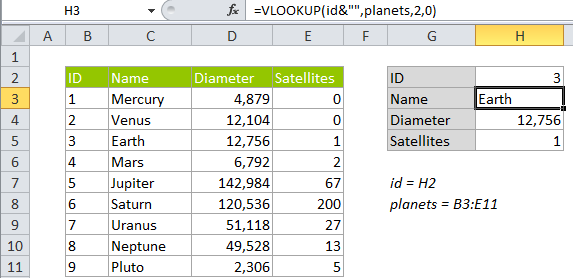
This tutorial shows how to calculate VLOOKUP with numbers and text in Excel using the example below;

Formula

=VLOOKUP(val&"",table,col,0)
Explanation

A common problem with VLOOKUP is a mismatch between numbers and text. Either the first column in the table contains lookup values that are numbers stored as text, or the table contains numbers, but the lookup value itself is a number stored as text.

In either case, VLOOKUP will return an #N/A error, even when there appears to be a match. In the example below, each planet has an id based on position from the sun. In cell H3 we have a simple VLOOKUP formula looking for the number 3 from cell H2. The result is the #N/A error, even though 3 is clearly in the table.
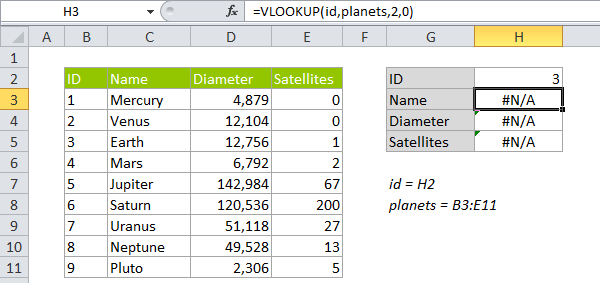
One solution is to convert both the first column in the table and the lookup value to the same type: either numbers or text. However, if you don’t have control over both the table and the lookup value, or if it’s simply not practical to convert values, you can modify the VLOOKUP formula to coerce the lookup value to match the type in the table. In this case, we can revise the VLOOKUP formula to concatenate an empty string to the lookup value, which converts the lookup value to text:

=VLOOKUP(id,planets,2,0)    // original
=VLOOKUP(id&"",planets,2,0) // revised

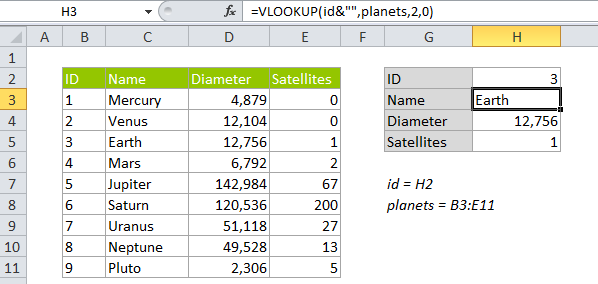
In the worksheet, the revised formula takes care of the error:
How this formula works

When you concatenate an empty string (“”) to a number, it converts the number to text. You could also do the same thing with a longer formula that utilizes the TEXT function to convert to text :

=VLOOKUP(TEXT(id,"@"),planets,2,0)

If you have both numbers and text

If you can’t be certain when you’ll have numbers and when you’ll have text, you can cater to both options by wrapping VLOOKUP in IFERROR and writing a formula that handles both cases:

=IFERROR(VLOOKUP(id,planets,3,0),VLOOKUP(id&"",planets,3,0))

Here, we first try a straight VLOOKUP formula that assumes both lookup value and the first column in the tables are numbers. If that throws and error, we try again with the revised formula. If that fails, VLOOKUP will return the #N/A error.

Post navigation

Previous Post:

COSH function: Description, Usage, Syntax, Examples and Explanation

Next Post:

Excel Data validation require unique number

Leave a Reply Cancel reply

Your email address will not be published. Required fields are marked *

Learn Basic Excel

Ribbon
Workbook
Worksheets
Format Cells
Find & Select
Sort & Filter
Templates
Print
Share
Protect
Keyboard Shortcuts

Categories

  • Charts
  • Data Analysis
  • Data Validation
  • Excel Functions
    • Cube Functions
    • Database Functions
    • Date and Time Functions
    • Engineering Functions
    • Financial Functions
    • Information Functions
    • Logical Functions
    • Lookup and Reference Functions
    • Math and Trig Functions
    • Statistical Functions
    • Text Functions
    • Web Functions
  • Excel VBA
  • Excel Video Tutorials
  • Formatting
  • Grouping
  • Others

Logical Functions

  • How to use IFS function in Excel
  • How to use Excel XOR Function
  • OR function Examples in Excel
  • IF with wildcards in Excel
  • Not Equal To ‘<>‘ operator in Excel

Date Time

  • DAY function: Description, Usage, Syntax, Examples and Explanation
  • How to Calculate Age in Excel
  • How to calculate future date say 6 months ahead in Excel
  • Create date range from two dates in Excel
  • How to join date and text together in Excel

Grouping

  • Group times into unequal buckets in Excel
  • Calculate conditional mode with criteria in Excel
  • How to randomly assign people to groups in Excel
  • Map text to numbers in Excel
  • Group arbitrary text values in Excel

General

  • Count cells that do not contain errors in Excel
  • How to Insert Cells, Row and Rows in Excel
  • How to Create Calendar in Excel
  • How to count total number of cells in a rectangular range in Excel
  • How to generate random number between two numbers in Excel
© 2025 xlsoffice . All Right Reserved. | Teal Smiles | Abbreviations And Their Meaning