
Skip to content
Free Excel Tutorials
  • Home
  • Excel For Beginners
  • Excel Intermediate
  • Advanced Excel For Experts

Data Analysis

  • How To Filter Data in Excel
  • How to create Gauge Chart in Excel
  • Excel Frequency Function Example
  • Understanding Pivot Tables in Excel
  • Conditional Formatting Rules in Excel

References

  • Left Lookup in Excel
  • How to get last column number in range in Excel
  • How to calculate two-way lookup VLOOKUP in Excel Table
  • Count rows that contain specific values in Excel
  • Lookup entire row in Excel

Data Validations

  • Excel Data validation must begin with
  • Excel Data validation date in specific year
  • Excel Data validation only dates between
  • Excel Data validation date in next 30 days
  • Excel Data validation must contain specific text

Close and Open Excel Workbooks Through VBA

by

The Close and Open Method in Excel VBA can be used to close and open workbooks. Remember, the Workbooks collection contains all the Workbook objects that are currently open.

Place a command button on your worksheet and add the following code lines:

1. The code line below closes close-open-workbooks.xls.

Workbooks("close-open-workbooks.xls").Close

2. The code line below closes the first opened/created workbook.

Workbooks(1).Clos

3. The code line below closes the active workbook.

ActiveWorkbook.Close

4. The code line below closes all workbooks that are currently open.

Workbooks.Close

5. The code line below opens sales.xls.

Workbooks.Open ("sales.xls")

Note: you can only open sales.xls without specifying the file’s path if it’s stored in your default file location. The default file location is the folder you see when you open or save a file.

6. You can also use the GetOpenFilename method of the Application object to display the standard open Dialog box and select the file (without actually opening the file).

Dim MyFile As String
MyFile = Application.GetOpenFilename()

Result:
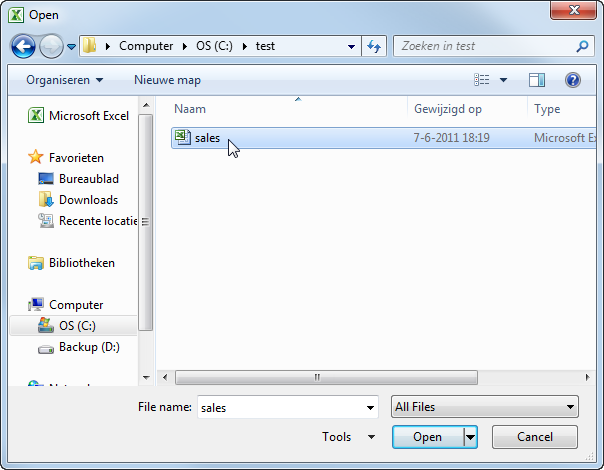
7. Next, you can open the workbook as usual.

Workbooks.Open (MyFile)

Post navigation

Previous Post:

How to use Excel CHOOSE Function

Next Post:

Customize Ribbon In Excel

Leave a Reply Cancel reply

Your email address will not be published. Required fields are marked *

Learn Basic Excel

Ribbon
Workbook
Worksheets
Format Cells
Find & Select
Sort & Filter
Templates
Print
Share
Protect
Keyboard Shortcuts

Categories

  • Charts
  • Data Analysis
  • Data Validation
  • Excel Functions
    • Cube Functions
    • Database Functions
    • Date and Time Functions
    • Engineering Functions
    • Financial Functions
    • Information Functions
    • Logical Functions
    • Lookup and Reference Functions
    • Math and Trig Functions
    • Statistical Functions
    • Text Functions
    • Web Functions
  • Excel VBA
  • Excel Video Tutorials
  • Formatting
  • Grouping
  • Others

Logical Functions

  • IF with wildcards in Excel
  • NOT function: Description, Usage, Syntax, Examples and Explanation
  • IFS function: Description, Usage, Syntax, Examples and Explanation
  • How to use Excel AND Function
  • OR function Examples in Excel

Date Time

  • Count times in a specific range in Excel
  • MINUTE function: Description, Usage, Syntax, Examples and Explanation
  • Basic timesheet formula with breaks in Excel
  • Convert decimal minutes to Excel time
  • Get week number from date in Excel

Grouping

  • Group numbers at uneven intervals in Excel
  • How to randomly assign people to groups in Excel
  • Group times into 3 hour buckets in Excel
  • Map text to numbers in Excel
  • Running count group by n size in Excel

General

  • How to calculate decrease by percentage in Excel
  • Check if multiple cells have same value with case sensitive in Excel
  • Common Errors in Excel
  • 3D SUMIF for multiple worksheets in Excel
  • Zoom Worksheet in Excel
© 2026 xlsoffice . All Right Reserved. | Teal Smiles | Abbreviations And Their Meaning