
Skip to content
Free Excel Tutorials
  • Home
  • Excel For Beginners
  • Excel Intermediate
  • Advanced Excel For Experts

Data Analysis

  • How to Use Solver Tool in Excel
  • Reverse List in Excel
  • How To Perform and Interpret Regression Analysis in Excel
  • Working With Tables in Excel
  • How to Sort by Color in Excel

References

  • Two-column Lookup in Excel
  • Create hyperlink with VLOOKUP in Excel
  • How to use Excel LOOKUP Function
  • How to calculate two-way lookup VLOOKUP in Excel Table
  • How to use Excel MMULT Function

Data Validations

  • Excel Data validation exists in list
  • Excel Data validation allow weekday only
  • Excel Data validation unique values only
  • Excel Data validation must contain specific text
  • Excel Data validation date in next 30 days

How to Sum Range with Errors in Excel

by

This example shows you how to create an array formula that sums a range with errors. You can also use the AGGREGATE function to sum a range with errors.

1. We use the IFERROR function to check for an error.
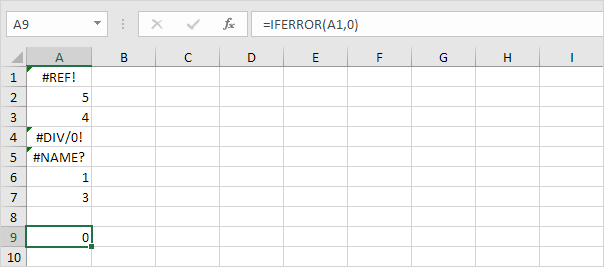
Explanation: the IFERROR function returns 0, if an error is found. If not, it returns the value of the cell.

2. To sum the range with errors (don’t be overwhelmed), we add the SUM function and replace A1 with A1:A7.
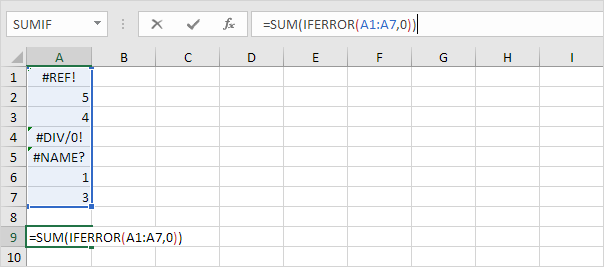
3. Finish by pressing CTRL + SHIFT + ENTER.
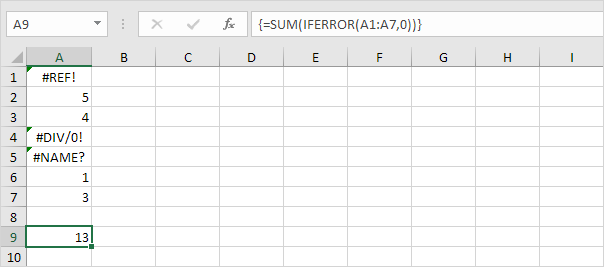
Note: The formula bar indicates that this is an array formula by enclosing it in curly braces {}. Do not type these yourself. They will disappear when you edit the formula.

Explanation: The range (array constant) created by the IFERROR function is stored in Excel’s memory, not in a range. The array constant looks as follows:

{0;5;4;0;0;1;3}

This array constant is used as an argument for the SUM function, giving a result of 13.

Post navigation

Previous Post:

COSH function: Description, Usage, Syntax, Examples and Explanation

Next Post:

Excel Data validation require unique number

Leave a Reply Cancel reply

Your email address will not be published. Required fields are marked *

Learn Basic Excel

Ribbon
Workbook
Worksheets
Format Cells
Find & Select
Sort & Filter
Templates
Print
Share
Protect
Keyboard Shortcuts

Categories

  • Charts
  • Data Analysis
  • Data Validation
  • Excel Functions
    • Cube Functions
    • Database Functions
    • Date and Time Functions
    • Engineering Functions
    • Financial Functions
    • Information Functions
    • Logical Functions
    • Lookup and Reference Functions
    • Math and Trig Functions
    • Statistical Functions
    • Text Functions
    • Web Functions
  • Excel VBA
  • Excel Video Tutorials
  • Formatting
  • Grouping
  • Others

Logical Functions

  • AND function: Description, Usage, Syntax, Examples and Explanation
  • How to use Excel XOR Function
  • SWITCH function example in Excel
  • How to return blank in place of #DIV/0! error in Excel
  • Not Equal To ‘<>‘ operator in Excel

Date Time

  • How to Calculate Age in Excel
  • Add decimal minutes to time in Excel
  • Get first day of month in Excel
  • EOMONTH function: Description, Usage, Syntax, Examples and Explanation
  • NETWORKDAYS.INTL function: Description, Usage, Syntax, Examples and Explanation

Grouping

  • Map text to numbers in Excel
  • Categorize text with keywords in Excel
  • Group times into 3 hour buckets in Excel
  • Calculate conditional mode with criteria in Excel
  • Group numbers with VLOOKUP in Excel

General

  • Hide and Unhide Columns or Rows in Excel
  • Freeze and Unfreeze Panes in Excel
  • How to create dynamic worksheet reference in Excel
  • Convert column number to letter in Excel
  • How to get amount with percentage in Excel
© 2025 xlsoffice . All Right Reserved. | Teal Smiles | Abbreviations And Their Meaning