
Skip to content
Free Excel Tutorials
  • Home
  • Excel For Beginners
  • Excel Intermediate
  • Advanced Excel For Experts

Data Analysis

  • Get column name from index in Excel Table
  • How to Sort by Color in Excel
  • How To Filter Data in Excel
  • Understanding Anova in Excel
  • Understanding Pivot Tables in Excel

References

  • INDEX function: Description, Usage, Syntax, Examples and Explanation
  • Two-way lookup with VLOOKUP in Excel
  • How to get relative row numbers in a range in Excel
  • How to get last row in mixed data with blanks in Excel
  • How to use Excel INDIRECT Function

Data Validations

  • Excel Data validation don’t exceed total
  • Excel Data validation exists in list
  • Excel Data validation date in specific year
  • Excel Data validation must begin with
  • Excel Data validation unique values only

Sum if equal to either x or y in Excel

by

This tutorial shows how to Sum if equal to either x or y in Excel using the example below;

In the example, we are summing all sales from either the West OR North region.
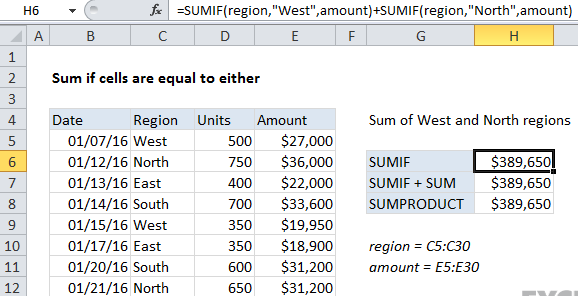
Explanation

If you need to sum numbers based on other cells being equal to either one value or another (either x or y), you can use the SUMIF function.

The formula in cell H6 is:

=SUMIF(region,"West",amount)+SUMIF(region,"North",amount)

Where region is a named range for C5:C30 and amount is a named range for E5:E30.

Each instance of SUMIF provides a subtotal, one for sales in the West, one for sales in the North. The formula simply adds these two results together.

SUMIF with an array constant

A more elegant solution is to give the SUMIF function more than one value for the criteria, using an array constant. To do this, construct a normal SUMIF, but package the criteria in array syntax — curly braces, with individual items separated by commas.  Finally, wrap the entire SUMIF function in the SUM function. This is necessary because SUMIF will return one result for each item in the criteria array and these results need to be added together:

The formula in cell H7 is:

=SUM(SUMIF(region,{"West","North"},amount))

Criteria as reference

If you want to supply criteria as a range (a reference), you’ll need to enter as an array formula with control + shift + enter:

{=SUM(SUMIF(region,criteria,amount))}

where criteria is a range like A1:A2.

SUMPRODUCT alternative

You can also use SUMPRODUCT to sum cells with OR logic. The formula in cell H8 is:

=SUMPRODUCT(amount *((region="West") + (region="North")))

This could also be written as:

=SUMPRODUCT(amount*(region={"West","North"}))

SUMPRODUCT is not as fast as SUMIF, but the speed difference is not noticeable with smaller data sets.

Post navigation

Previous Post:

How to use Excel CHOOSE Function

Next Post:

Customize Ribbon In Excel

Leave a Reply Cancel reply

Your email address will not be published. Required fields are marked *

Learn Basic Excel

Ribbon
Workbook
Worksheets
Format Cells
Find & Select
Sort & Filter
Templates
Print
Share
Protect
Keyboard Shortcuts

Categories

  • Charts
  • Data Analysis
  • Data Validation
  • Excel Functions
    • Cube Functions
    • Database Functions
    • Date and Time Functions
    • Engineering Functions
    • Financial Functions
    • Information Functions
    • Logical Functions
    • Lookup and Reference Functions
    • Math and Trig Functions
    • Statistical Functions
    • Text Functions
    • Web Functions
  • Excel VBA
  • Excel Video Tutorials
  • Formatting
  • Grouping
  • Others

Logical Functions

  • IF, AND, OR and NOT Functions Examples in Excel
  • IF with boolean logic in Excel
  • IFERROR function: Description, Usage, Syntax, Examples and Explanation
  • Nested IF function example in Excel
  • Check multiple cells are equal in Excel

Date Time

  • How to determine year is a leap year in Excel
  • Get month from date in Excel
  • Sum through n months in Excel
  • EOMONTH function: Description, Usage, Syntax, Examples and Explanation
  • How to show last updated date stamp in Excel

Grouping

  • Map inputs to arbitrary values in Excel
  • Group numbers with VLOOKUP in Excel
  • Group numbers at uneven intervals in Excel
  • How to randomly assign data to groups in Excel
  • Group arbitrary text values in Excel

General

  • Index and match on multiple columns in Excel
  • Customize Ribbon In Excel
  • How to Delete Cells, Row and Rows in Excel
  • Count cells that contain errors in Excel
  • Currency vs Accounting Format in Excel
© 2026 xlsoffice . All Right Reserved. | Teal Smiles | Abbreviations And Their Meaning