

Skip to content
Free Excel Tutorials
  • Home
  • Excel For Beginners
  • Excel Intermediate
  • Advanced Excel For Experts

Data Analysis

  • Data Series in Excel
  • Create Scatter Chart in Excel
  • Working With Tables in Excel
  • Remove Duplicates Example in Excel
  • Everything about Charts in Excel

References

  • How to get last row in text data in Excel
  • Create hyperlink with VLOOKUP in Excel
  • Multi-criteria lookup and transpose in Excel
  • Get nth match with INDEX / MATCH in Excel
  • Extract data with helper column in Excel

Data Validations

  • Prevent invalid data entering in specific cells
  • Excel Data validation only dates between
  • How To Create Drop-down List in Excel
  • Excel Data validation date in next 30 days
  • Data validation must not exist in list

Customize Ribbon In Excel

by

Excel Ribbon: Navigation, Customizing and Collapsing. 

Navigate through Excel Ribbon

Excel Ribbon are directly below File, Home, Insert, Page layout, Formulas, Data, Review and View tabs.

Excel selects the ribbon’s Home tab when you open a workbook.

You can checkout our previous post on Working with Excel ribbon.

Customize Excel Ribbon

The essence of customizing the ribbon is mainly to add more command icons that are needed by the computer user.

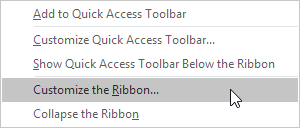
Step 1. Right click anywhere on the ribbon, and then click Customize the Ribbon.
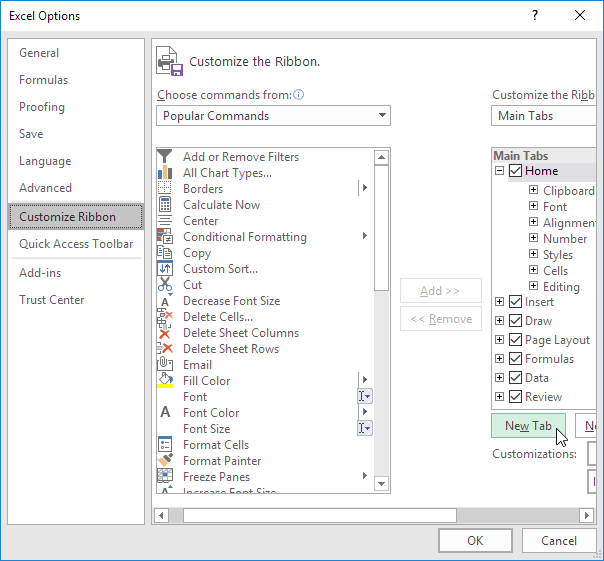
Step 2. Click New Tab.
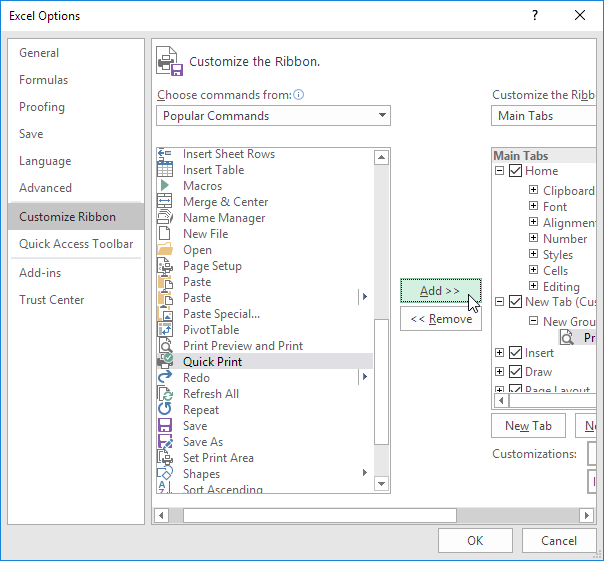
Step 3. Add the commands you like.
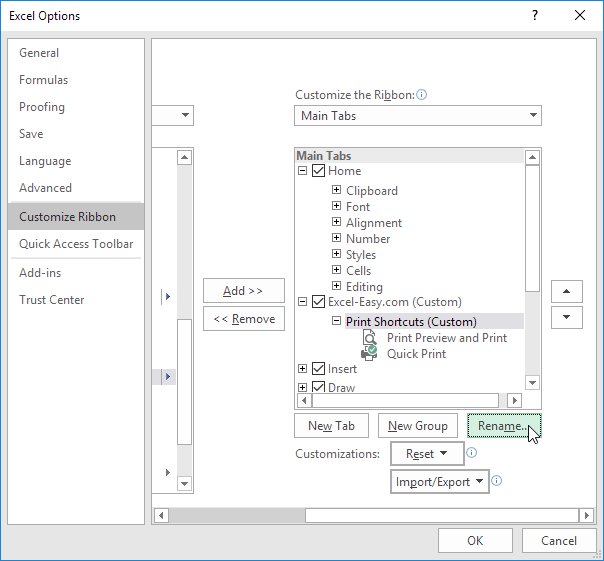
Step 4. Rename the tab and group.
You can easily create your own tab and add commands to it.

you can also add new groups to existing tabs. To hide a tab, uncheck the corresponding check box. Click Reset, Reset all customizations, to delete all Ribbon and Quick Access Toolbar customizations.

Collapse the Ribbon

You can collapse the ribbon to get extra space on the screen.

There are 3 Ways to Collapse Ribbon in Excel

  • Right click anywhere on the ribbon, and then click Collapse the Ribbon
  • Using Excel Shortcut — press CTRL + F1
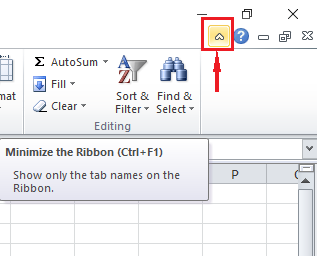
  • Click the icon by the top most right as shown below:
Post navigation

Previous Post:

VLOOKUP without #N/A error in Excel

Next Post:

Manipulating text strings using Left, Mid, Right, Len, Substitute in Excel

Leave a Reply Cancel reply

Your email address will not be published. Required fields are marked *

Learn Basic Excel

Ribbon
Workbook
Worksheets
Format Cells
Find & Select
Sort & Filter
Templates
Print
Share
Protect
Keyboard Shortcuts

Categories

  • Charts
  • Data Analysis
  • Data Validation
  • Excel Functions
    • Cube Functions
    • Database Functions
    • Date and Time Functions
    • Engineering Functions
    • Financial Functions
    • Information Functions
    • Logical Functions
    • Lookup and Reference Functions
    • Math and Trig Functions
    • Statistical Functions
    • Text Functions
    • Web Functions
  • Excel VBA
  • Excel Video Tutorials
  • Formatting
  • Grouping
  • Others

Logical Functions

  • How to return blank in place of #DIV/0! error in Excel
  • XOR function: Description, Usage, Syntax, Examples and Explanation
  • Extract multiple matches into separate rows in Excel
  • Check multiple cells are equal in Excel
  • Not Equal To ‘<>‘ operator in Excel

Date Time

  • DAY function: Description, Usage, Syntax, Examples and Explanation
  • Get days between dates in Excel
  • DAYS360 function: Description, Usage, Syntax, Examples and Explanation
  • Convert date to text in Excel
  • Get days between dates ignoring years in Excel

Grouping

  • Group times into 3 hour buckets in Excel
  • How to randomly assign data to groups in Excel
  • Map inputs to arbitrary values in Excel
  • Map text to numbers in Excel
  • Group numbers at uneven intervals in Excel

General

  • Count cells that contain errors in Excel
  • Convert column letter to number in Excel
  • Mark Workbook as Final in Excel
  • Count cells that do not contain errors in Excel
  • Common Errors in Excel
© 2025 xlsoffice . All Right Reserved. | Teal Smiles | Abbreviations And Their Meaning