
Skip to content
Free Excel Tutorials
  • Home
  • Excel For Beginners
  • Excel Intermediate
  • Advanced Excel For Experts

Data Analysis

  • How to create Checklist in Excel
  • How to do a t-Test in Excel?
  • How to Create One and Two Variable Data Tables in Excel
  • How to create running total in an Excel Table
  • How to Use Solver Tool in Excel

References

  • How to use Excel ROW Function
  • How to get last column number in range in Excel
  • How to use Excel MMULT Function
  • How to get first column number in range in Excel
  • How to use Excel VLOOKUP Function

Data Validations

  • Prevent invalid data entering in specific cells
  • Excel Data validation unique values only
  • Excel Data validation only dates between
  • Excel Data validation require unique number
  • Excel Data validation don’t exceed total

Average top 3 scores in Excel

by

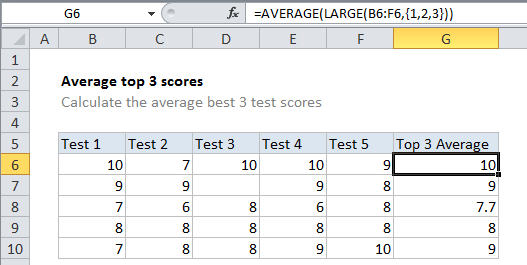
This tutorial shows how to work  Average top 3 scores in Excel using the example below;

Formula

=AVERAGE(LARGE(range,{1,2,3}))
Explanation

To average the top 3 scores in a data set, you can use a formula based on the LARGE function.

In the example shown, the formula in G6 is:

=AVERAGE(LARGE(B6:F6,{1,2,3}))

How this formula works

The LARGE function can retrieve the top nth value from a set of values. So, for example LARGE(A1:A10,1) will return highest value, LARGE(A1:A10,2) will return the 2nd highest value, and so on.

In this case, we are asking for more than one value by passing the array constant {1,2,3} into LARGE for the second argument. This causes LARGE to return an array result that includes the highest 3 values. The AVERAGE function then returns the average of these values.

The AVERAGE function is programmed to automatically handle array results, so it is not necessary to use Ctrl+Shift+Enter (CSE) to enter the formula.

Post navigation

Previous Post:

How to use Excel CHOOSE Function

Next Post:

Customize Ribbon In Excel

Leave a Reply Cancel reply

Your email address will not be published. Required fields are marked *

Learn Basic Excel

Ribbon
Workbook
Worksheets
Format Cells
Find & Select
Sort & Filter
Templates
Print
Share
Protect
Keyboard Shortcuts

Categories

  • Charts
  • Data Analysis
  • Data Validation
  • Excel Functions
    • Cube Functions
    • Database Functions
    • Date and Time Functions
    • Engineering Functions
    • Financial Functions
    • Information Functions
    • Logical Functions
    • Lookup and Reference Functions
    • Math and Trig Functions
    • Statistical Functions
    • Text Functions
    • Web Functions
  • Excel VBA
  • Excel Video Tutorials
  • Formatting
  • Grouping
  • Others

Logical Functions

  • NOT function: Description, Usage, Syntax, Examples and Explanation
  • Nested IF function example in Excel
  • IFNA function: Description, Usage, Syntax, Examples and Explanation
  • SWITCH function: Description, Usage, Syntax, Examples and Explanation
  • Complete List of Excel Logical Functions, References and Examples

Date Time

  • Add years to date in Excel
  • Count day of week between dates in Excel
  • Two ways to sum time over 30 minutes in Excel
  • Add days exclude certain days of week in Excel
  • How to calculate next anniversary date or birthday in Excel

Grouping

  • How to randomly assign data to groups in Excel
  • Group times into unequal buckets in Excel
  • Calculate conditional mode with criteria in Excel
  • If cell contains one of many things in Excel
  • Group times into 3 hour buckets in Excel

General

  • How to fill cell ranges with random text values in Excel
  • Lock Cells in a Worksheet Excel
  • Cell References: Relative, Absolute and Mixed Referencing Examples
  • How to count total number of cells in a rectangular range in Excel
  • How to calculate profit margin percentage in Excel
© 2026 xlsoffice . All Right Reserved. | Teal Smiles | Abbreviations And Their Meaning