
Skip to content
Free Excel Tutorials
  • Home
  • Excel For Beginners
  • Excel Intermediate
  • Advanced Excel For Experts

Data Analysis

  • How to combine 2 or more chart types in a single chart in Excel
  • How To Load Analysis ToolPak in Excel
  • Excel Bar Chart
  • Create Scatter Chart in Excel
  • Excel Line Chart

References

  • How to use Excel ROW Function
  • Complete List of Excel Lookup and Reference Functions, References and Examples
  • Excel Advanced Lookup using Index and Match Functions
  • How to get last row in text data in Excel
  • Convert text string to valid reference in Excel using Indirect function

Data Validations

  • Excel Data validation date in next 30 days
  • Excel Data validation unique values only
  • Excel Data validation don’t exceed total
  • Excel Data validation exists in list
  • Excel Data validation allow weekday only

Highlight unprotected cells in Excel

by

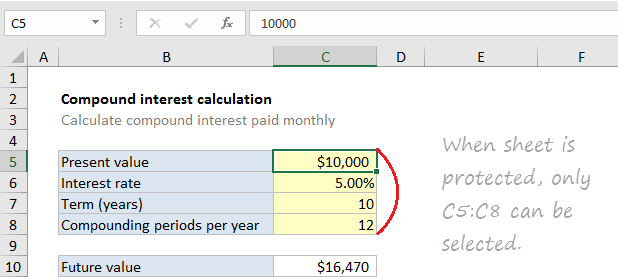
This tutorial shows how to Highlight unprotected cells in Excel using the example below;

Formula

=CELL("PROTECT",A1)=0
Explanation

To highlight unprotected cells (cells that are unlocked) with conditional formatting, you can use a formula based on the CELL function. In the example shown, the custom formula used to set up conditional formatting is:

=CELL("PROTECT",A1)=0

Where A1 represents the active cell in the selection when the rule was defined.

How this formula works

The CELL function can provide a wide range of information about cell properties. One property is called “protect” and indicates whether a cell is unlocked or locked. All cells start out “locked” in a new Excel workbook, but this setting has no effect until a worksheet is protected.

The CELL function returns either 1 or zero to indicate “on” or “off”. In this case we are comparing the result to zero, so when CELL returns 0, the expression returns TRUE and the conditional formatting is triggered. When CELL returns 1, the expression returns FALSE and no conditional formatting is applied.

Post navigation

Previous Post:

COSH function: Description, Usage, Syntax, Examples and Explanation

Next Post:

Excel Data validation require unique number

Leave a Reply Cancel reply

Your email address will not be published. Required fields are marked *

Learn Basic Excel

Ribbon
Workbook
Worksheets
Format Cells
Find & Select
Sort & Filter
Templates
Print
Share
Protect
Keyboard Shortcuts

Categories

  • Charts
  • Data Analysis
  • Data Validation
  • Excel Functions
    • Cube Functions
    • Database Functions
    • Date and Time Functions
    • Engineering Functions
    • Financial Functions
    • Information Functions
    • Logical Functions
    • Lookup and Reference Functions
    • Math and Trig Functions
    • Statistical Functions
    • Text Functions
    • Web Functions
  • Excel VBA
  • Excel Video Tutorials
  • Formatting
  • Grouping
  • Others

Logical Functions

  • How to use Excel TRUE Function
  • SWITCH function: Description, Usage, Syntax, Examples and Explanation
  • Extract multiple matches into separate rows in Excel
  • Not Equal To ‘<>‘ operator in Excel
  • IFERROR function: Description, Usage, Syntax, Examples and Explanation

Date Time

  • Create date range from two dates in Excel
  • DATEVALUE function: Description, Usage, Syntax, Examples and Explanation
  • TODAY function: Description, Usage, Syntax, Examples and Explanation
  • Add business days to date in Excel
  • SECOND function: Description, Usage, Syntax, Examples and Explanation

Grouping

  • Group times into 3 hour buckets in Excel
  • How to randomly assign people to groups in Excel
  • Group arbitrary text values in Excel
  • If cell contains one of many things in Excel
  • Group numbers with VLOOKUP in Excel

General

  • Mark Workbook as Final in Excel
  • 44 Practical Excel IF function Examples
  • How to make excel worksheets print on one page?
  • Check if multiple cells have same value with case sensitive in Excel
  • How to add sequential row numbers to a set of data in Excel
© 2026 xlsoffice . All Right Reserved. | Teal Smiles | Abbreviations And Their Meaning