
Skip to content
Free Excel Tutorials
  • Home
  • Excel For Beginners
  • Excel Intermediate
  • Advanced Excel For Experts

Data Analysis

  • How to Create Area Chart in Excel
  • Subtotal function in Excel
  • What-If Analysis: Scenarios and Goal Seek in Excel
  • How to count table columns in Excel
  • Excel Pie Chart

References

  • Multi-criteria lookup and transpose in Excel
  • Lookup entire row in Excel
  • How to get last row in numeric data in Excel
  • How to get address of named range in Excel
  • Vlookup Examples in Excel

Data Validations

  • Excel Data validation whole percentage only
  • Excel Data validation allow weekday only
  • How To Create Drop-down List in Excel
  • Excel Data validation must not contain
  • Excel Data validation unique values only

Remove line breaks in a cell in Excel

by

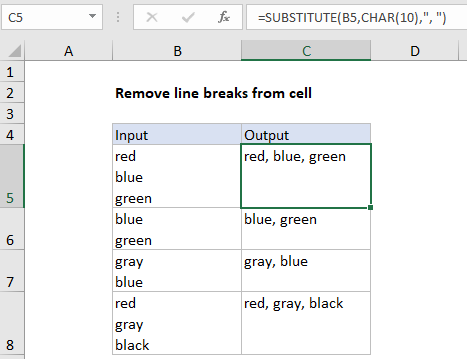
To remove line breaks from a cell, or from text inside a formula, you can use a formula based on the SUBSTITUTE and CHAR functions.

Formula

=SUBSTITUTE(A1,CHAR(10),", ")
Explanation

In the example shown, the formula in C5 is:

=SUBSTITUTE(B5,CHAR(10),", ")

which replaces line breaks in B5 with commas.

How this formula works

First, you should know that Excel contains two functions, CLEAN and TRIM, that can automatically remove line breaks and extra spaces from text. For example to strip all line breaks from a cell, you could use:

=CLEAN(B5)

In this case, however, we are removing line breaks and replacing them with commas, so we are using the SUBSTITUTE function instead of CLEAN. SUBSTITUTE can locate matching text anywhere in a cell, and replace it with the text of your choice. SUBSTITUTE can accept up to four arguments, but we are using only the first three like this:

=SUBSTITUTE(B5,CHAR(10),", ")

The text comes from cell B5.

The “old text” is entered as CHAR(10). This will match the line break character used in Windows.

The “new text” is entered as “, “. This translates to a comma plus one space. We need the quotes because this is a text value.

SUBSTITUTE then replaces all line breaks in the cell with commas and returns the final result as text in C5. Because “old text” is an argument, you can change the comma to any other text you like.

Post navigation

Next Post:

Create One-dimensional and Two-dimensional Array

Leave a Reply Cancel reply

Your email address will not be published. Required fields are marked *

Learn Basic Excel

Ribbon
Workbook
Worksheets
Format Cells
Find & Select
Sort & Filter
Templates
Print
Share
Protect
Keyboard Shortcuts

Categories

  • Charts
  • Data Analysis
  • Data Validation
  • Excel Functions
    • Cube Functions
    • Database Functions
    • Date and Time Functions
    • Engineering Functions
    • Financial Functions
    • Information Functions
    • Logical Functions
    • Lookup and Reference Functions
    • Math and Trig Functions
    • Statistical Functions
    • Text Functions
    • Web Functions
  • Excel VBA
  • Excel Video Tutorials
  • Formatting
  • Grouping
  • Others

Logical Functions

  • Not Equal To ‘<>‘ operator in Excel
  • FALSE function: Description, Usage, Syntax, Examples and Explanation
  • How to use Excel FALSE Function
  • IFS function: Description, Usage, Syntax, Examples and Explanation
  • How to use IFS function in Excel

Date Time

  • Display the current date and time in Excel
  • WEEKNUM function: Description, Usage, Syntax, Examples and Explanation
  • Calculate days remaining in Excel
  • Calculate number of hours between two times in Excel
  • Convert Unix time stamp to Excel date

Grouping

  • Calculate conditional mode with criteria in Excel
  • Categorize text with keywords in Excel
  • Running count group by n size in Excel
  • Map text to numbers in Excel
  • How to randomly assign people to groups in Excel

General

  • Count cells that contain errors in Excel
  • Print Excel Sheet In Landscape Or Portrait
  • Delete Blank Rows at Once in Excel
  • Convert column letter to number in Excel
  • Spell Check in Excel
© 2026 xlsoffice . All Right Reserved. | Teal Smiles | Abbreviations And Their Meaning