
Skip to content
Free Excel Tutorials
  • Home
  • Excel For Beginners
  • Excel Intermediate
  • Advanced Excel For Experts

Data Analysis

  • Excel Frequency Function Example
  • Excel Bar Chart
  • How to Create Gantt Chart in Excel
  • Number and Text Filters Examples in Excel
  • How to create running total in an Excel Table

References

  • INDEX function: Description, Usage, Syntax, Examples and Explanation
  • Complete List of Excel Lookup and Reference Functions, References and Examples
  • Create hyperlink with VLOOKUP in Excel
  • How to get address of named range in Excel
  • How to get relative column numbers in a range in Excel

Data Validations

  • Excel Data validation exists in list
  • Excel Data validation must begin with
  • Excel Data validation date in next 30 days
  • Data validation must not exist in list
  • Excel Data validation unique values only

How to split text with delimiter in Excel

by

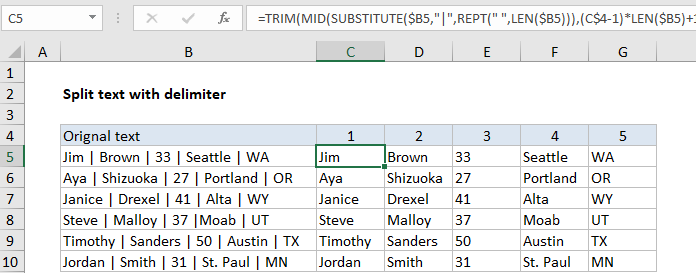
To split text at an arbitrary delimiter (comma, space, pipe, etc.) you can use a formula based on the TRIM, MID, SUBSTITUTE, REPT, and LEN functions.

Formula

=TRIM(MID(SUBSTITUTE(A1,delim,REPT
(" ",LEN(A1))),(N-1)*LEN(A1)+1,LEN(A1)))
Explanation

In the example shown, the formula in C5 is:

=TRIM(MID(SUBSTITUTE($B5,"|",
REPT(" ",LEN($B5))),(C$4-1)*
LEN($B5)+1,LEN($B5)))

Note: references to B5 and C4 are mixed references to allow the formula to be copied across and down.

How this formula works

The gist of this formula is to replace a given delimiter with a large number of spaces using SUBSTITUTE and REPT, then use the MID function to extract text related to the “nth occurrence” and the TRIM function to get rid of the extra space.

In this snippet, the delimiter (delim) is replaced with a number of spaces equal to the total length of the string:

SUBSTITUTE(A1,delim,REPT(" ",LEN(A1)))

Then the formula uses the MID function to extract the nth substring. The starting point is calculated with the code below, where N represents “nth”:

(N-1)*LEN(A1)+1

The total characters extracted is equal to the length of the full text string. The TRIM function then removes all extra spaces and returns just the nth string.

Extract just one instance

Although the example is set up to extract 5 substrings from the text in column B, you can easily extract just 1 instance. For example, to extract just the 4th item (city), you could use:

=TRIM(MID(SUBSTITUTE(B5,"|",REPT
(" ",LEN(B5))),(4-1)*LEN(B5)+1,LEN(B5)))

Text to Columns feature

For manual, one-off conversions, Excel has a built-in feature called “Text to Columns” that can split text in cells with a delimiter of your choice. You’ll find this feature on the the Data tab of the ribbon in the Data tools section.

Post navigation

Next Post:

Create One-dimensional and Two-dimensional Array

Leave a Reply Cancel reply

Your email address will not be published. Required fields are marked *

Learn Basic Excel

Ribbon
Workbook
Worksheets
Format Cells
Find & Select
Sort & Filter
Templates
Print
Share
Protect
Keyboard Shortcuts

Categories

  • Charts
  • Data Analysis
  • Data Validation
  • Excel Functions
    • Cube Functions
    • Database Functions
    • Date and Time Functions
    • Engineering Functions
    • Financial Functions
    • Information Functions
    • Logical Functions
    • Lookup and Reference Functions
    • Math and Trig Functions
    • Statistical Functions
    • Text Functions
    • Web Functions
  • Excel VBA
  • Excel Video Tutorials
  • Formatting
  • Grouping
  • Others

Logical Functions

  • Invoice status with nested if in Excel
  • How to use Excel XOR Function
  • Complete List of Excel Logical Functions, References and Examples
  • Excel If, Nested If, And/Or Criteria Examples
  • IFNA function: Description, Usage, Syntax, Examples and Explanation

Date Time

  • Generate series of dates by weekends in Excel
  • How to calculate next scheduled event in Excel
  • Convert text date dd/mm/yy to mm/dd/yy in Excel
  • Get days before a date in Excel
  • Sum race time splits in Excel

Grouping

  • If cell contains one of many things in Excel
  • Group times into 3 hour buckets in Excel
  • Group numbers with VLOOKUP in Excel
  • Group times into unequal buckets in Excel
  • Categorize text with keywords in Excel

General

  • Lock Cells in a Worksheet Excel
  • How to add sequential row numbers to a set of data in Excel
  • Find, Select, Replace and Go To Special in Excel
  • Basic text sort formula in Excel
  • Excel Ribbon Quick Overview For Beginners
© 2026 xlsoffice . All Right Reserved. | Teal Smiles | Abbreviations And Their Meaning