
Skip to content
Free Excel Tutorials
  • Home
  • Excel For Beginners
  • Excel Intermediate
  • Advanced Excel For Experts

Data Analysis

  • Add Outline to Data in Excel
  • Use Data Form to input, edit and delete records in Excel
  • Understanding Pivot Tables in Excel
  • How To Compare Two Lists in Excel
  • How to create dynamic reference table name in Excel

References

  • How to get address of last cell in range in Excel
  • Multi-criteria lookup and transpose in Excel
  • How to get relative column numbers in a range in Excel
  • To count total rows in a range in Excel
  • How to calculate two-way lookup VLOOKUP in Excel Table

Data Validations

  • How To Create Drop-down List in Excel
  • Excel Data validation require unique number
  • Excel Data validation date in next 30 days
  • Excel Data validation exists in list
  • Prevent invalid data entering in specific cells

How To Use AGGREGATE function to sum a range with errors in Excel

by

Excel functions such as SUM, COUNT, LARGE and MAX don’t work if a range includes errors. However, you can easily use the AGGREGATE function to fix this.

1. For example, Excel returns an error if you use the SUM function to sum a range with errors.
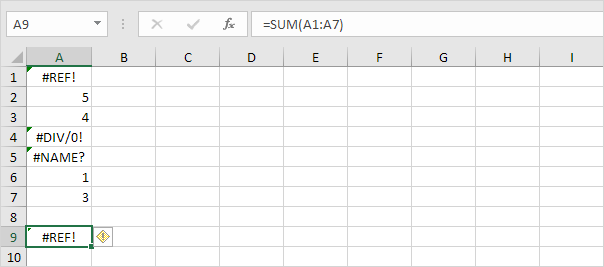
2. Use the AGGREGATE function to sum a range with errors.
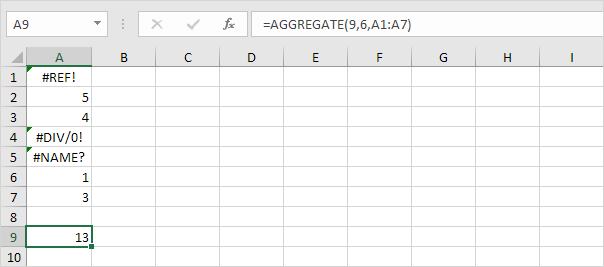
Explanation: the first argument (9) tells Excel that you want to use the SUM function. The second argument (6) tells Excel that you want to ignore error values.

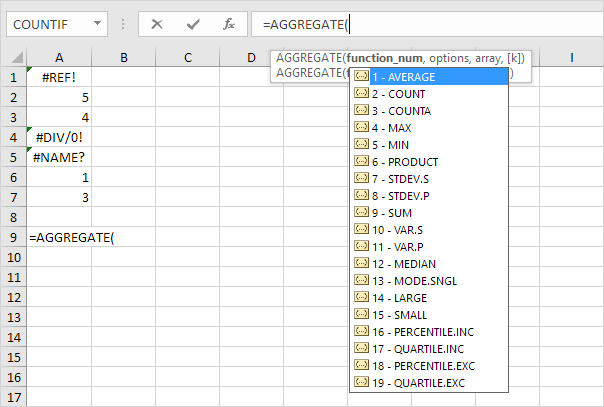
3. It’s not easy to remember which argument belongs to which function. Fortunately, the AutoComplete feature in Excel helps you with this.
4. The AGGREGATE function below finds the second to largest number in a range with errors.
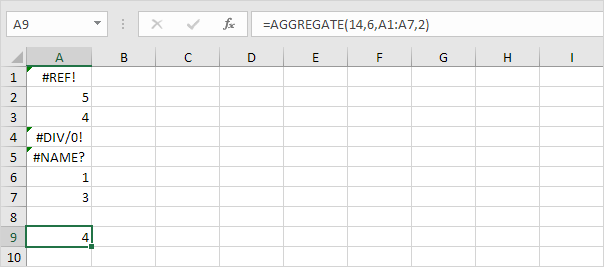
Explanation: the first argument (14) tells Excel that you want to use the LARGE function. The second argument (6) tells Excel that you want to ignore error values. The fourth argument (2) tells Excel that you want to find the second to largest number.

5. The AGGREGATE function below finds the maximum value ignoring error values and hidden rows.
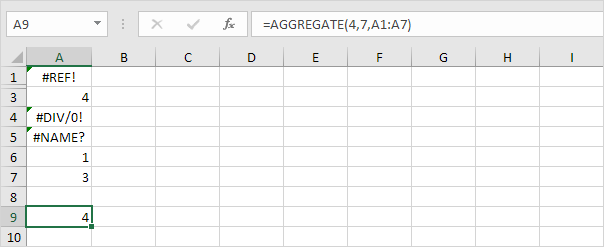
Explanation: the first argument (4) tells Excel that you want to use the MAX function. The second argument (7) tells Excel that you want to ignore error values and hidden rows. In this example, row 2 is hidden.

Post navigation

Previous Post:

VLOOKUP without #N/A error in Excel

Next Post:

Manipulating text strings using Left, Mid, Right, Len, Substitute in Excel

Leave a Reply Cancel reply

Your email address will not be published. Required fields are marked *

Learn Basic Excel

Ribbon
Workbook
Worksheets
Format Cells
Find & Select
Sort & Filter
Templates
Print
Share
Protect
Keyboard Shortcuts

Categories

  • Charts
  • Data Analysis
  • Data Validation
  • Excel Functions
    • Cube Functions
    • Database Functions
    • Date and Time Functions
    • Engineering Functions
    • Financial Functions
    • Information Functions
    • Logical Functions
    • Lookup and Reference Functions
    • Math and Trig Functions
    • Statistical Functions
    • Text Functions
    • Web Functions
  • Excel VBA
  • Excel Video Tutorials
  • Formatting
  • Grouping
  • Others

Logical Functions

  • IFS function: Description, Usage, Syntax, Examples and Explanation
  • AND function: Description, Usage, Syntax, Examples and Explanation
  • IF, AND, OR and NOT Functions Examples in Excel
  • SWITCH function example in Excel
  • Extract multiple matches into separate rows in Excel

Date Time

  • Excel Date & Time Functions Example
  • How to get number of days, weeks, months or years between two dates in Excel
  • How to calculate workdays per month in Excel
  • Get project end date in Excel
  • How to calculate Quarter of Date in Excel

Grouping

  • Map text to numbers in Excel
  • Group times into 3 hour buckets in Excel
  • If cell contains one of many things in Excel
  • Categorize text with keywords in Excel
  • Group numbers with VLOOKUP in Excel

General

  • Delete Blank Rows at Once in Excel
  • How to count total columns in range in Excel
  • How to create dynamic named range with INDEX in Excel
  • Freeze and Unfreeze Panes in Excel
  • How to password protect excel sheet?
© 2025 xlsoffice . All Right Reserved. | Teal Smiles | Abbreviations And Their Meaning