

Skip to content
Free Excel Tutorials
  • Home
  • Excel For Beginners
  • Excel Intermediate
  • Advanced Excel For Experts

Data Analysis

  • How to Create Gantt Chart in Excel
  • How to sum a total in multiple Excel tables
  • Randomize/ Shuffle List in Excel
  • Filter Data Based on Date in Excel
  • How to calculate average last N values in a table in Excel

References

  • Two-way lookup with VLOOKUP in Excel
  • How to get address of first cell in range in Excel
  • Multi-criteria lookup and transpose in Excel
  • INDEX function: Description, Usage, Syntax, Examples and Explanation
  • Vlookup Examples in Excel

Data Validations

  • Excel Data validation date in next 30 days
  • Excel Data validation must contain specific text
  • Excel Data validation only dates between
  • Excel Data validation no punctuation
  • Excel Data validation require unique number

Join Text Strings Using Concatenate or ‘& Operator’ in Excel

by

This example illustrates how to concatenate (join) strings in Excel. When joining text and a number, use the TEXT function to format that number.

1. Simply use the & operator to join strings.
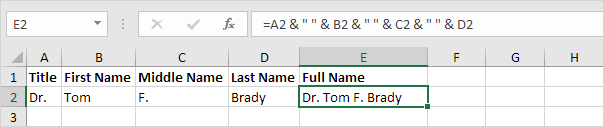
Note: to insert a space, use ” ”

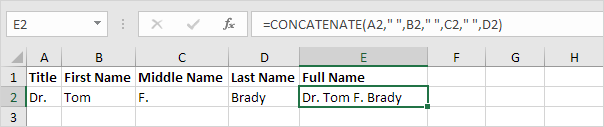
2. The CONCATENATE function produces the exact same result.
3a. The CONCAT function in Excel 2016 produces the exact same result.
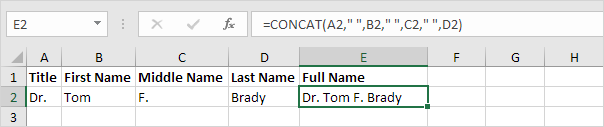
3b. The CONCAT function can also join a range of strings. If you don’t need a delimiter (space, comma, dash, etc.) this can be useful.

4a. The CONCAT function cannot ignore empty cells. Take a look at all the extra spaces in column E below when you drag the function in cell E2 down to cell E11.
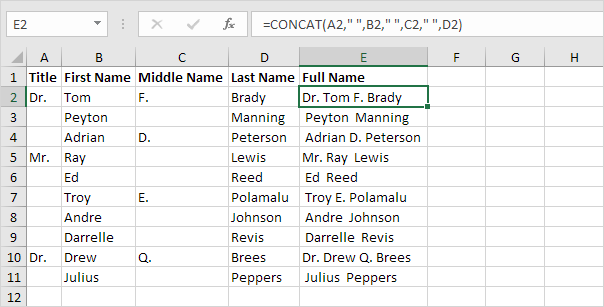
4b. The beauty of the TEXTJOIN function in Excel 2016 is that it can ignore empty cells (if the second argument is set to TRUE).
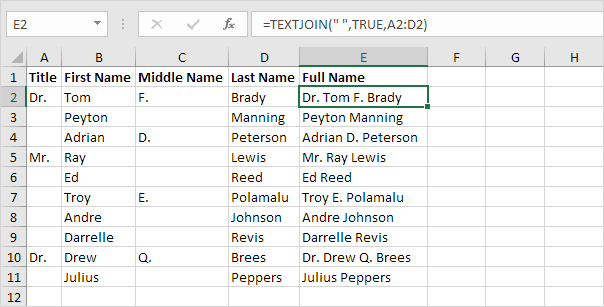
Note: the TEXTJOIN function joins a range of strings using a delimiter (first argument).

5a. When joining text and a number, use the TEXT function to format that number. Without using the TEXT function this would be the result.

5b. With the TEXT function.

Note: #,## is used to add comma’s to large numbers. Use 0 to display the nearest integer value. Use 0.0 for one decimal place. Use 0.00 for two decimal places, etc. You can also use the TEXT function to apply a percentage format and to format a date.

6. When concatenating strings, use CHAR(10) to insert a line break. For example, the address below contains two line breaks.
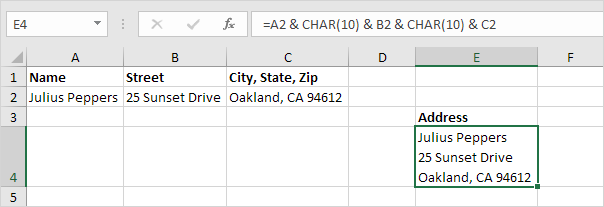
Note: don’t forget to enable text wrapping.

Post navigation

Previous Post:

VLOOKUP without #N/A error in Excel

Next Post:

Manipulating text strings using Left, Mid, Right, Len, Substitute in Excel

Leave a Reply Cancel reply

Your email address will not be published. Required fields are marked *

Learn Basic Excel

Ribbon
Workbook
Worksheets
Format Cells
Find & Select
Sort & Filter
Templates
Print
Share
Protect
Keyboard Shortcuts

Categories

  • Charts
  • Data Analysis
  • Data Validation
  • Excel Functions
    • Cube Functions
    • Database Functions
    • Date and Time Functions
    • Engineering Functions
    • Financial Functions
    • Information Functions
    • Logical Functions
    • Lookup and Reference Functions
    • Math and Trig Functions
    • Statistical Functions
    • Text Functions
    • Web Functions
  • Excel VBA
  • Excel Video Tutorials
  • Formatting
  • Grouping
  • Others

Logical Functions

  • How to use Excel AND Function
  • How to use IFS function in Excel
  • Check multiple cells are equal in Excel
  • How to use Excel OR Function
  • IF function: Description, Usage, Syntax, Examples and Explanation

Date Time

  • Steps to create Dynamic calendar grid in Excel
  • Convert Excel time to Unix time in Excel
  • WORKDAY function: Description, Usage, Syntax, Examples and Explanation
  • Add workdays to date custom weekends in Excel
  • Two ways to sum time over 30 minutes in Excel

Grouping

  • Categorize text with keywords in Excel
  • How to randomly assign people to groups in Excel
  • How to randomly assign data to groups in Excel
  • Group numbers at uneven intervals in Excel
  • Running count group by n size in Excel

General

  • Creating and Opening an existing file in Excel
  • Hide and Unhide Columns or Rows in Excel
  • Split Cell Content Using Text to Columns in Excel
  • Select, Insert, Rename, Move, Delete Worksheets in Excel
  • Find, Trace and Correct Errors in Excel Formulas using ‘Formula Auditing’
© 2026 xlsoffice . All Right Reserved. | Teal Smiles | Abbreviations And Their Meaning