
Skip to content
Free Excel Tutorials
  • Home
  • Excel For Beginners
  • Excel Intermediate
  • Advanced Excel For Experts

Data Analysis

  • How To Sort One Column or Multiple Columns in Excel
  • Excel Bar Chart
  • How to combine 2 or more chart types in a single chart in Excel
  • Conditional Formatting Icon Sets Examples in Excel
  • Working With Tables in Excel

References

  • Count rows that contain specific values in Excel
  • How to get relative row numbers in a range in Excel
  • Vlookup Examples in Excel
  • How to get last row in numeric data in Excel
  • Last row number in range

Data Validations

  • Prevent invalid data entering in specific cells
  • Excel Data validation unique values only
  • Excel Data validation allow weekday only
  • Excel Data validation date in next 30 days
  • Excel Data validation don’t exceed total

Win loss points calculation in Excel

by

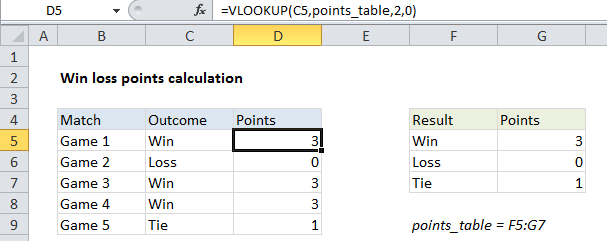
This tutorial shows how to work Win loss points calculation in Excel using the example below;

To assign points based on win/loss/tie results for a team, you can use a simple VLOOKUP formula, or a nested IF formula, as explained below.

Formula

=VLOOKUP(result,points_table,2,0)
Explanation

In the example shown, the formula in D5 is:

=VLOOKUP(C5,points_table,2,0)

How this formula works

This is a very simple application of the VLOOKUP function set for “exact match”:

  • lookup value comes from C5
  • table array is the named range “points_table” (F5:G7)
  • column index is 2, since points are in column G
  • range lookup is 0 (FALSE) to force exact match

Because we are using VLOOKUP in exact match mode, the points table does not need to be sorted in any particular way.

VLOOKUP is a nice solution in this case if you want to display the points table as a “key” for reference on the worksheet. If you don’t need to do this, see the nested IF version below.

Nested IF version

To calculate win/loss/tie points with the IF function, you can use a simple nested IF:

=IF(C5="Win",3,IF(C5="Loss",0,IF(C5="Tie",1)))

Post navigation

Previous Post:

COSH function: Description, Usage, Syntax, Examples and Explanation

Next Post:

Excel Data validation require unique number

Leave a Reply Cancel reply

Your email address will not be published. Required fields are marked *

Learn Basic Excel

Ribbon
Workbook
Worksheets
Format Cells
Find & Select
Sort & Filter
Templates
Print
Share
Protect
Keyboard Shortcuts

Categories

  • Charts
  • Data Analysis
  • Data Validation
  • Excel Functions
    • Cube Functions
    • Database Functions
    • Date and Time Functions
    • Engineering Functions
    • Financial Functions
    • Information Functions
    • Logical Functions
    • Lookup and Reference Functions
    • Math and Trig Functions
    • Statistical Functions
    • Text Functions
    • Web Functions
  • Excel VBA
  • Excel Video Tutorials
  • Formatting
  • Grouping
  • Others

Logical Functions

  • IF function: Description, Usage, Syntax, Examples and Explanation
  • TRUE function: Description, Usage, Syntax, Examples and Explanation
  • XOR function: Description, Usage, Syntax, Examples and Explanation
  • How to use Excel AND Function
  • SWITCH function example in Excel

Date Time

  • EOMONTH function: Description, Usage, Syntax, Examples and Explanation
  • How to determine year is a leap year in Excel
  • Display Days in month in Excel
  • DATE function: Description, Usage, Syntax, Examples and Explanation
  • Count birthdays by month in Excel

Grouping

  • Running count group by n size in Excel
  • Calculate conditional mode with criteria in Excel
  • Group times into unequal buckets in Excel
  • Group arbitrary text values in Excel
  • How to randomly assign people to groups in Excel

General

  • Create dynamic workbook reference to another workbook in Excel
  • With vs Without Array Formula in Excel
  • How to calculate percent of goal in Excel
  • How to password protect excel sheet?
  • How to generate random number weighted probability in Excel
© 2025 xlsoffice . All Right Reserved. | Teal Smiles | Abbreviations And Their Meaning