
Skip to content
Free Excel Tutorials
  • Home
  • Excel For Beginners
  • Excel Intermediate
  • Advanced Excel For Experts

Data Analysis

  • How to Create Thermometer Chart in Excel
  • Conditional Formatting Icon Sets Examples in Excel
  • How to combine 2 or more chart types in a single chart in Excel
  • Conditional Formatting Rules in Excel
  • Excel Bar Chart

References

  • Left Lookup in Excel
  • Last row number in range
  • How to use Excel VLOOKUP Function
  • Count rows that contain specific values in Excel
  • Perform case-sensitive Lookup in Excel

Data Validations

  • Excel Data validation date in next 30 days
  • Excel Data validation allow uppercase only
  • Excel Data validation with conditional list
  • Data validation must not exist in list
  • Excel Data validation date in specific year

Understanding Named Range, Named Constant, Name Manager in Excel Formulas

by

By using names  you can make your formulas much easier to understand and maintain i.e to update, audit, and manage.

You can define a name for a cell range, function, constant, or table.

Name: A word or string of characters in Excel that represents a cell, range of cells, formula, or constant value.

Named Range

To create a named range, execute the following steps.

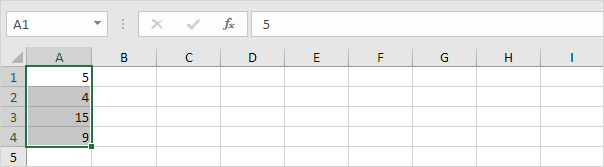
1. Select the range A1:A4.
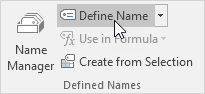
2. On the Formulas tab, in the Defined Names group, click Define Name.
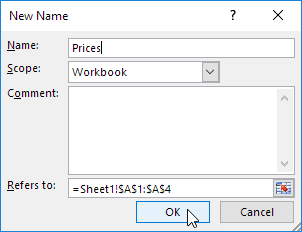
3. Enter a name and click OK.
There’s an even quicker way of doing this.

4. Select the range, type the name in the Name box and press Enter.

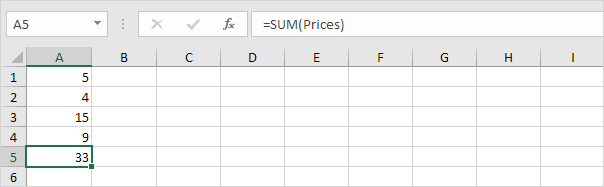
5. Now you can use this named range in your formulas. For example, sum Prices.
Named Constant

To create a named constant, execute the following steps.

1. On the Formulas tab, in the Defined Names group, click Define Name.

2. Enter a name, type a value, and click OK.
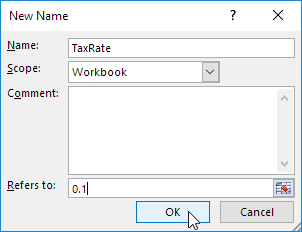
3. Now you can use this named constant in your formulas.
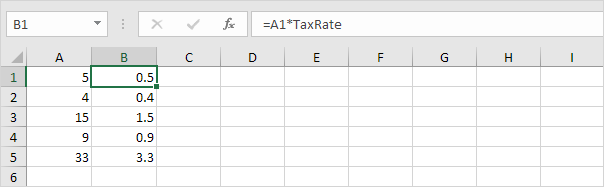
Note: if the tax rate changes, use the Name Manager to edit the name and Excel automatically updates all the formulas that use TaxRate.

Name Manager

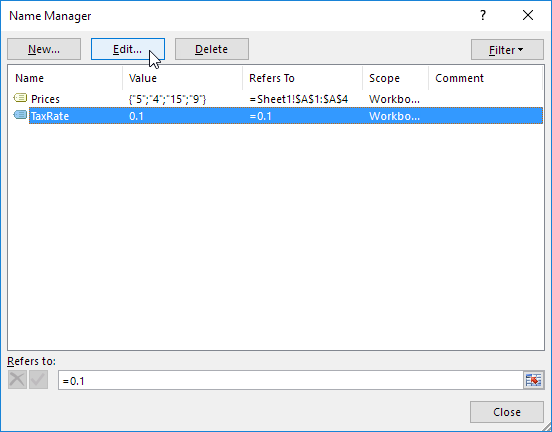
To edit and delete defined names, execute the following steps.

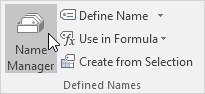
1. On the Formulas tab, in the Defined Names group, click Name Manager.
2. For example, select TaxRate and click Edit.
Post navigation

Previous Post:

TRUE function: Description, Usage, Syntax, Examples and Explanation

Next Post:

Excel Pie Chart

Leave a Reply Cancel reply

Your email address will not be published. Required fields are marked *

Learn Basic Excel

Ribbon
Workbook
Worksheets
Format Cells
Find & Select
Sort & Filter
Templates
Print
Share
Protect
Keyboard Shortcuts

Categories

  • Charts
  • Data Analysis
  • Data Validation
  • Excel Functions
    • Cube Functions
    • Database Functions
    • Date and Time Functions
    • Engineering Functions
    • Financial Functions
    • Information Functions
    • Logical Functions
    • Lookup and Reference Functions
    • Math and Trig Functions
    • Statistical Functions
    • Text Functions
    • Web Functions
  • Excel VBA
  • Excel Video Tutorials
  • Formatting
  • Grouping
  • Others

Logical Functions

  • How to use Excel FALSE Function
  • Return blank if in Excel
  • SWITCH function: Description, Usage, Syntax, Examples and Explanation
  • SWITCH function example in Excel
  • IF function: Description, Usage, Syntax, Examples and Explanation

Date Time

  • Add business days to date in Excel
  • Display the current date in Excel
  • Add workdays no weekends in Excel
  • Pad week numbers with zeros in Excel
  • How to get Holiday Date from Year in Excel

Grouping

  • How to randomly assign people to groups in Excel
  • Group times into 3 hour buckets in Excel
  • Group arbitrary text values in Excel
  • Map inputs to arbitrary values in Excel
  • Calculate conditional mode with criteria in Excel

General

  • Currency vs Accounting Format in Excel
  • Using Existing Templates in Excel
  • Create dynamic workbook reference to another workbook in Excel
  • Flash Fill in Excel
  • Excel Operators
© 2026 xlsoffice . All Right Reserved. | Teal Smiles | Abbreviations And Their Meaning