

Skip to content
Free Excel Tutorials
  • Home
  • Excel For Beginners
  • Excel Intermediate
  • Advanced Excel For Experts

Data Analysis

  • Calculate Conditional Percentile ‘IF’ in table in Excel
  • Error Bars in Excel
  • Remove Duplicates Example in Excel
  • Reverse List in Excel
  • How to create dynamic reference table name in Excel

References

  • Count unique text values with criteria
  • How to get last row in text data in Excel
  • Two-way lookup with VLOOKUP in Excel
  • Count rows that contain specific values in Excel
  • Lookup entire row in Excel

Data Validations

  • Excel Data validation allow uppercase only
  • Excel Data validation specific characters only
  • Prevent invalid data entering in specific cells
  • Excel Data validation exists in list
  • Excel Data validation with conditional list

Lock Cells in a Worksheet Excel

by
  • Lock specific areas of a worksheet

You can lock cells in Excel if you want to protect cells from being edited. In this example, we will lock cell A2.
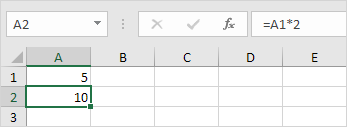
Before you start: by default, all cells are locked. However, locking cells has no effect until you protect the worksheet. So when you protect a worksheet, all your cells (=worksheet) will be locked. As a result, if you want to lock a cell, you have to unlock all cells first, lock a cell, and then protect the sheet.

1. Select all cells.
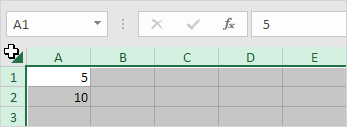
2. Right click, and then click Format Cells.

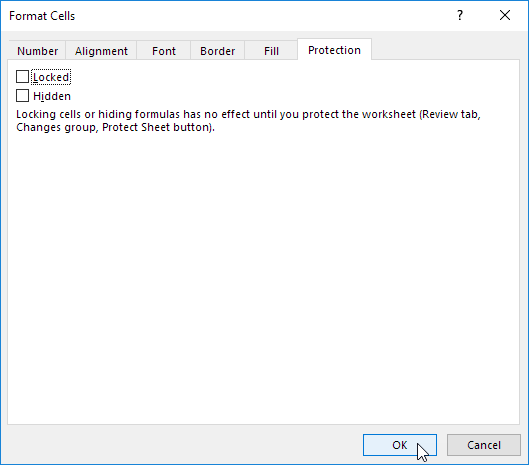
3. On the Protection tab, uncheck the Locked check box and click OK.
4. Right click cell A2, and then click Format Cells.

5. On the Protection tab, check the Locked check box and click OK.
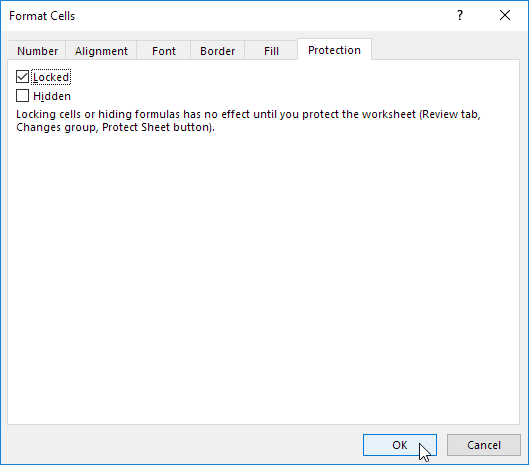
Note: if you also check the Hidden check box, users cannot see the formula in the formula bar when they select cell A2.

6. Protect the sheet.

Cell A2 is locked now. To edit cell A2, you have to unprotect the sheet.

Post navigation

Previous Post:

COSH function: Description, Usage, Syntax, Examples and Explanation

Next Post:

Excel Data validation require unique number

Leave a Reply Cancel reply

Your email address will not be published. Required fields are marked *

Learn Basic Excel

Ribbon
Workbook
Worksheets
Format Cells
Find & Select
Sort & Filter
Templates
Print
Share
Protect
Keyboard Shortcuts

Categories

  • Charts
  • Data Analysis
  • Data Validation
  • Excel Functions
    • Cube Functions
    • Database Functions
    • Date and Time Functions
    • Engineering Functions
    • Financial Functions
    • Information Functions
    • Logical Functions
    • Lookup and Reference Functions
    • Math and Trig Functions
    • Statistical Functions
    • Text Functions
    • Web Functions
  • Excel VBA
  • Excel Video Tutorials
  • Formatting
  • Grouping
  • Others

Logical Functions

  • Not Equal To ‘<>‘ operator in Excel
  • TRUE function: Description, Usage, Syntax, Examples and Explanation
  • How to use Excel XOR Function
  • Extract multiple matches into separate rows in Excel
  • How to use Excel TRUE Function

Date Time

  • NOW function: Description, Usage, Syntax, Examples and Explanation
  • EOMONTH function: Description, Usage, Syntax, Examples and Explanation
  • How to calculate most recent day of week in Excel
  • SECOND function: Description, Usage, Syntax, Examples and Explanation
  • TIME function: Description, Usage, Syntax, Examples and Explanation

Grouping

  • Group numbers with VLOOKUP in Excel
  • Group times into unequal buckets in Excel
  • Map text to numbers in Excel
  • Calculate conditional mode with criteria in Excel
  • How to randomly assign data to groups in Excel

General

  • Spell Check in Excel
  • How to calculate percent variance in Excel
  • Sum by group in Excel
  • How to test a range for numbers in Excel
  • Cell References: Relative, Absolute and Mixed Referencing Examples
© 2026 xlsoffice . All Right Reserved. | Teal Smiles | Abbreviations And Their Meaning