

Skip to content
Free Excel Tutorials
  • Home
  • Excel For Beginners
  • Excel Intermediate
  • Advanced Excel For Experts

Data Analysis

  • How To Filter Data in Excel
  • Reverse List in Excel
  • Subtotal function in Excel
  • How to create a Histogram in Excel
  • Get column name from index in Excel Table

References

  • CHOOSE function: Description, Usage, Syntax, Examples and Explanation
  • Merge tables with VLOOKUP in Excel
  • Last row number in range
  • Extract data with helper column in Excel
  • Perform case-sensitive Lookup in Excel

Data Validations

  • Excel Data validation exists in list
  • Excel Data validation number multiple 100
  • Excel Data validation whole percentage only
  • How To Create Drop-down List in Excel
  • Excel Data validation only dates between

How To Create Budget in Excel

by

This chapter shows you one of the many powerful features Excel has to offer.

The example below illustrates how to create a budget in Excel.

1. Enter the different type of income and expenses in column A.
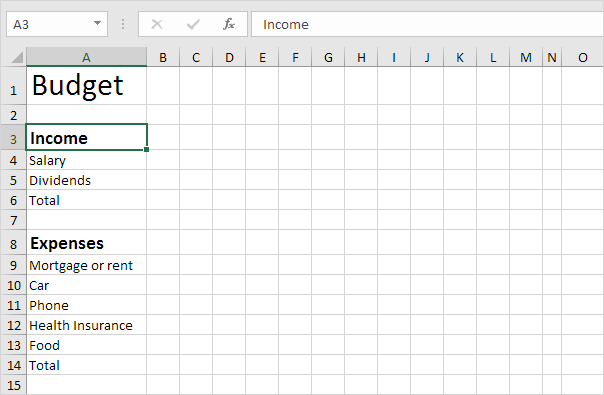
Note: On the Home tab, in the Font group, you can use the different commands to change the font size and font style of text. Click on the right border of the column A header to increase the column width.

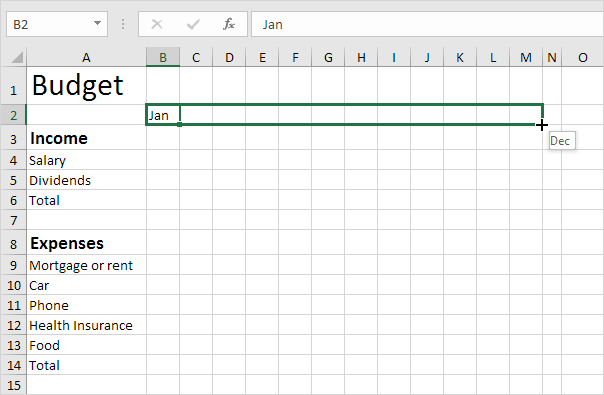
2. Enter the word Jan into cell B2. Next, select cell B2, click the lower right corner of the cell and drag it across to cell M2. Excel automatically adds the other months.
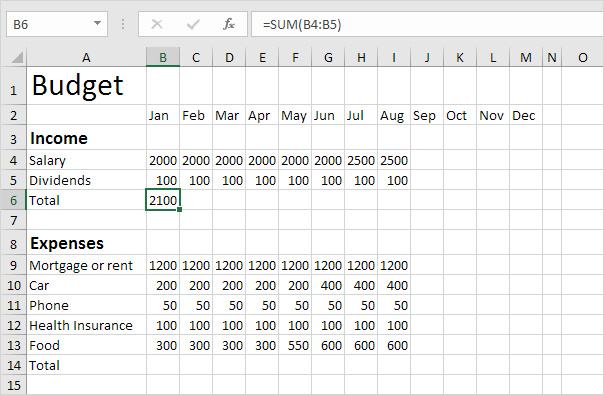
3. Enter some data.

4. Enter the SUM function into cell B6. To achieve this, select cell B6, type an equal sign (=), enter SUM(, select the range B4:B5, close with a “)” and press Enter.
Note: On the Home tab, in the Font group, you can add a top border.

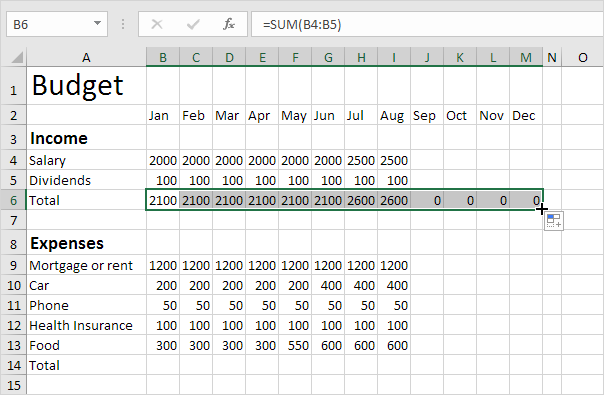
5. Select cell B6, click the lower right corner of the cell and drag it across to cell M6. Excel copies the function and border to the other cells.
6. Enter the SUM function into cell O4. Remember, select cell O4, type =SUM(, select the range B4:M4, close with a “)” and press Enter.

7. Drag cell O4 down to cell O6.
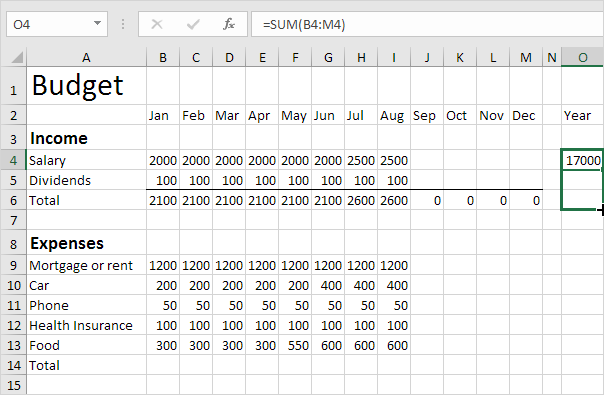
8. Repeat steps 4 to 7 for the expenses.

9. Add a Short/Extra row.
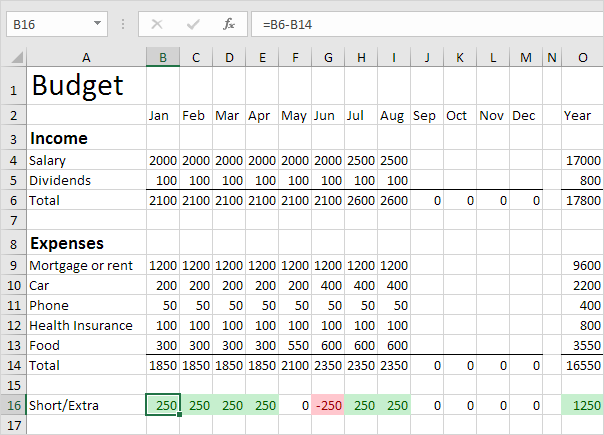
Explanation: The above example was achieved using two conditional formatting rules to highlight cells lower than 0 and greater than 0. Visit conditional formatting to learn more rules.

Post navigation

Previous Post:

VLOOKUP without #N/A error in Excel

Next Post:

Manipulating text strings using Left, Mid, Right, Len, Substitute in Excel

Leave a Reply Cancel reply

Your email address will not be published. Required fields are marked *

Learn Basic Excel

Ribbon
Workbook
Worksheets
Format Cells
Find & Select
Sort & Filter
Templates
Print
Share
Protect
Keyboard Shortcuts

Categories

  • Charts
  • Data Analysis
  • Data Validation
  • Excel Functions
    • Cube Functions
    • Database Functions
    • Date and Time Functions
    • Engineering Functions
    • Financial Functions
    • Information Functions
    • Logical Functions
    • Lookup and Reference Functions
    • Math and Trig Functions
    • Statistical Functions
    • Text Functions
    • Web Functions
  • Excel VBA
  • Excel Video Tutorials
  • Formatting
  • Grouping
  • Others

Logical Functions

  • How to use Excel OR Function
  • How to use Excel NOT Function
  • NOT function: Description, Usage, Syntax, Examples and Explanation
  • Invoice status with nested if in Excel
  • Not Equal To ‘<>‘ operator in Excel

Date Time

  • Display Days until expiration date in Excel
  • How to calculate months between dates in Excel
  • How to calculate next scheduled event in Excel
  • Convert decimal minutes to Excel time
  • Add days exclude certain days of week in Excel

Grouping

  • Map inputs to arbitrary values in Excel
  • Categorize text with keywords in Excel
  • Group numbers with VLOOKUP in Excel
  • Map text to numbers in Excel
  • How to randomly assign data to groups in Excel

General

  • Check if range contains a value not in another range in Excel
  • How to generate random times at specific intervals in Excel
  • Currency vs Accounting Format in Excel
  • How to choose page/paper size in Excel before Printing
  • Find, Select, Replace and Go To Special in Excel
© 2026 xlsoffice . All Right Reserved. | Teal Smiles | Abbreviations And Their Meaning