
Skip to content
Free Excel Tutorials
  • Home
  • Excel For Beginners
  • Excel Intermediate
  • Advanced Excel For Experts

Data Analysis

  • How To Create Frequency Distribution in Excel
  • How to count table rows in Excel
  • How to conditionally sum numeric data in an Excel table using SUMIFS
  • How to create a Histogram in Excel
  • How to create dynamic reference table name in Excel

References

  • To count total rows in a range in Excel
  • How to use Excel ROW Function
  • Extract all partial matches in Excel
  • How to use Excel MMULT Function
  • Find Closest Match in Excel Using INDEX, MATCH, ABS and MIN functions

Data Validations

  • Excel Data validation number multiple 100
  • Excel Data validation must contain specific text
  • Excel Data validation must not contain
  • Excel Data validation don’t exceed total
  • Prevent invalid data entering in specific cells

Convert Text to Numbers in Excel

by

By default, text is left-aligned and numbers are right-aligned in Excel.

Atimes user enter inverted comma before inputting data values in a cell which automatically converts a number to text.

This example teaches you how to convert ‘text strings that represent numbers’ to numbers.
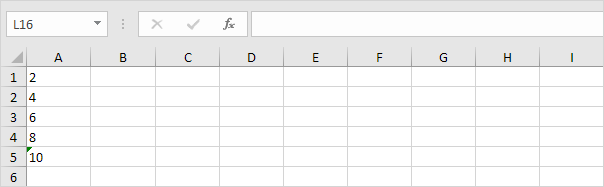
1. Select the range A1:A4 and change the number format to General.
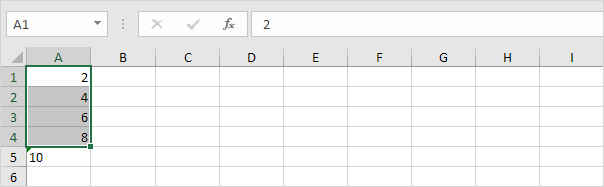
2. Numbers preceded by an apostrophe are also treated as text. Select cell A5 and manually remove the apostrophe.
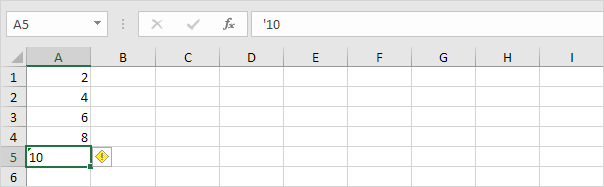
3a. You can also combine step 1 and 2 by adding an empty cell to the range A1:A5. By doing this, you let Excelknow that these text strings are numbers. Copy an empty cell.
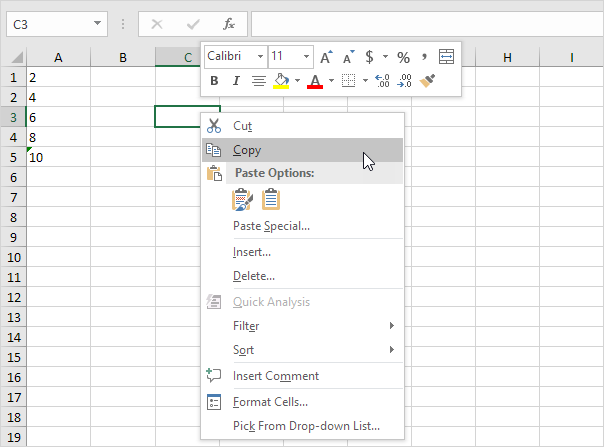
3b. Select the range A1:A5, right click, and then click Paste Special.

3c. Click Add.
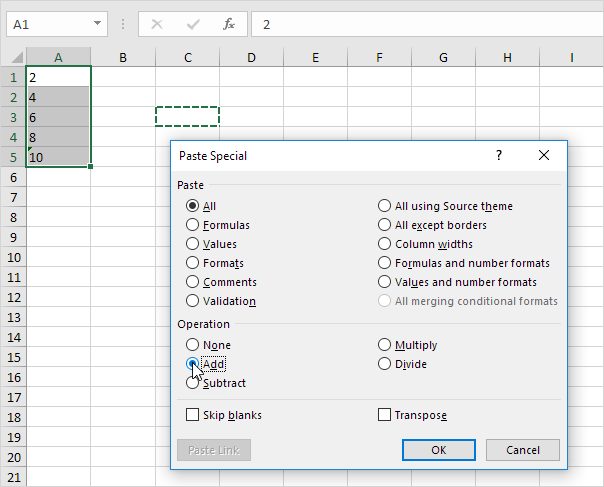
3d. Click OK.

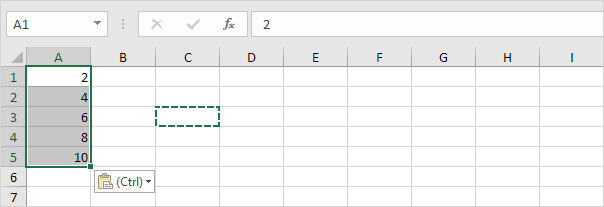
Result. All numbers are right-aligned and treated as numbers.
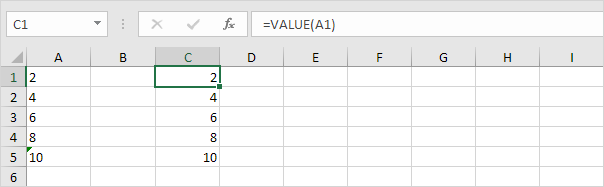
4a. You can also use the VALUE function.
4b. Here’s another example. Use the Right function (or any other text function) to extract characters from a text string and then use the VALUE function to convert these characters to a number.

Post navigation

Previous Post:

VLOOKUP without #N/A error in Excel

Next Post:

Manipulating text strings using Left, Mid, Right, Len, Substitute in Excel

Leave a Reply Cancel reply

Your email address will not be published. Required fields are marked *

Learn Basic Excel

Ribbon
Workbook
Worksheets
Format Cells
Find & Select
Sort & Filter
Templates
Print
Share
Protect
Keyboard Shortcuts

Categories

  • Charts
  • Data Analysis
  • Data Validation
  • Excel Functions
    • Cube Functions
    • Database Functions
    • Date and Time Functions
    • Engineering Functions
    • Financial Functions
    • Information Functions
    • Logical Functions
    • Lookup and Reference Functions
    • Math and Trig Functions
    • Statistical Functions
    • Text Functions
    • Web Functions
  • Excel VBA
  • Excel Video Tutorials
  • Formatting
  • Grouping
  • Others

Logical Functions

  • How to use IFS function in Excel
  • IFS function: Description, Usage, Syntax, Examples and Explanation
  • IF with wildcards in Excel
  • Check multiple cells are equal in Excel
  • Not Equal To ‘<>‘ operator in Excel

Date Time

  • How to get Weekdays, Working days between Two Dates in Excel
  • Add business days to date in Excel
  • NETWORKDAYS.INTL function: Description, Usage, Syntax, Examples and Explanation
  • Get last day of month in Excel
  • How to calculate next day of week in Excel

Grouping

  • If cell contains one of many things in Excel
  • How to randomly assign data to groups in Excel
  • Group numbers with VLOOKUP in Excel
  • How to randomly assign people to groups in Excel
  • Group arbitrary text values in Excel

General

  • How to generate random times at specific intervals in Excel
  • How to count total number of cells in a rectangular range in Excel
  • Subtotal by color in Excel
  • How to get amount with percentage in Excel
  • How to calculate percent sold in Excel
© 2026 xlsoffice . All Right Reserved. | Teal Smiles | Abbreviations And Their Meaning