
Skip to content
Free Excel Tutorials
  • Home
  • Excel For Beginners
  • Excel Intermediate
  • Advanced Excel For Experts

Data Analysis

  • Managing Conditional Formatting Rules in Excel
  • How To Insert and Customize Sparklines in Excel
  • What-If Analysis: Scenarios and Goal Seek in Excel
  • Excel Frequency Function Example
  • Data Series in Excel

References

  • How to use Excel OFFSET function
  • How to use Excel ROWS Function
  • Left Lookup in Excel
  • VLOOKUP function: Description, Usage, Syntax, Examples and Explanation
  • Merge tables with VLOOKUP in Excel

Data Validations

  • Excel Data validation unique values only
  • Excel Data validation require unique number
  • Excel Data validation allow uppercase only
  • Excel Data validation must contain specific text
  • Excel Data validation specific characters only

How to calculate Net Present Value (NPV) in Excel

by

NPV formula for net present value

To calculate Net Present Value (NPV) you can use the NPV function.

Formula

=NPV(rate,cashflows)-initialcost
Explanation

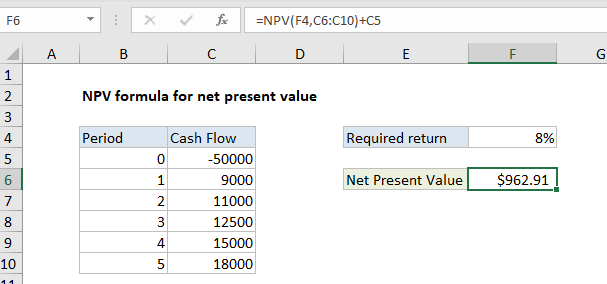
In the example shown, the formula in F6 is:

=NPV(F4,C6:C10)+C5

How this formula works

Net Present Value (NPV) is the present value of expected future cash flows minus the initial cost of investment. The NPV function in Excel only calculates the present value of uneven cashflows, so the initial cost must be handled explicitly.

One way to calculate Net Present Value in Excel is to use NPV to get the present value of all expected cash flows, then subtract the initial investment. This is the approach taken in the example shown, where the formula in F6 is:

=NPV(F4,C6:C10)+C5

The NPV function returns 50962.91. The initial investment (-50,000, recorded as a negative value because it is an outflow) is then added, and the final result is 962.91.

Post navigation

Previous Post:

DECIMAL function: Description, Usage, Syntax, Examples and Explanation

Next Post:

AVERAGE function: Description, Usage, Syntax, Examples and Explanation

Leave a Reply Cancel reply

Your email address will not be published. Required fields are marked *

Learn Basic Excel

Ribbon
Workbook
Worksheets
Format Cells
Find & Select
Sort & Filter
Templates
Print
Share
Protect
Keyboard Shortcuts

Categories

  • Charts
  • Data Analysis
  • Data Validation
  • Excel Functions
    • Cube Functions
    • Database Functions
    • Date and Time Functions
    • Engineering Functions
    • Financial Functions
    • Information Functions
    • Logical Functions
    • Lookup and Reference Functions
    • Math and Trig Functions
    • Statistical Functions
    • Text Functions
    • Web Functions
  • Excel VBA
  • Excel Video Tutorials
  • Formatting
  • Grouping
  • Others

Logical Functions

  • SWITCH function example in Excel
  • How to return blank in place of #DIV/0! error in Excel
  • AND function: Description, Usage, Syntax, Examples and Explanation
  • NOT function: Description, Usage, Syntax, Examples and Explanation
  • Extract multiple matches into separate rows in Excel

Date Time

  • Get last working day in month in Excel
  • How to calculate months between dates in Excel
  • How to enter Today’s Date or Static Date and Time in Excel
  • Find Last Day of the Month in Excel
  • How to get workdays between dates in Excel

Grouping

  • Group numbers at uneven intervals in Excel
  • Running count group by n size in Excel
  • Group times into unequal buckets in Excel
  • How to randomly assign data to groups in Excel
  • Group times into 3 hour buckets in Excel

General

  • How to calculate percent of goal in Excel
  • Index and match on multiple columns in Excel
  • How to count total number of cells in a rectangular range in Excel
  • Find, Select, Replace and Go To Special in Excel
  • Common Errors in Excel
© 2025 xlsoffice . All Right Reserved. | Teal Smiles | Abbreviations And Their Meaning