
Skip to content
Free Excel Tutorials
  • Home
  • Excel For Beginners
  • Excel Intermediate
  • Advanced Excel For Experts

Data Analysis

  • How to Create Thermometer Chart in Excel
  • How to sum a total in multiple Excel tables
  • Remove Duplicates Example in Excel
  • Chart Axes in Excel
  • How to Sort by Color in Excel

References

  • How to get last row in text data in Excel
  • Last row number in range
  • To count total rows in a range in Excel
  • MATCH function: Description, Usage, Syntax, Examples and Explanation
  • Two-way lookup with VLOOKUP in Excel

Data Validations

  • Excel Data validation whole percentage only
  • Data validation must not exist in list
  • Excel Data validation must contain specific text
  • Prevent invalid data entering in specific cells
  • Excel Data validation must begin with

Basic outline numbering in Excel

by

This tutorial shows how to create 1st and 2nd level outline formatting using excel formulas.

To generate basic outline numbering you can use COUNTA, MID, FIND, IF, and LEN functions.

Note: The formula used will only handle a 2-level outline.
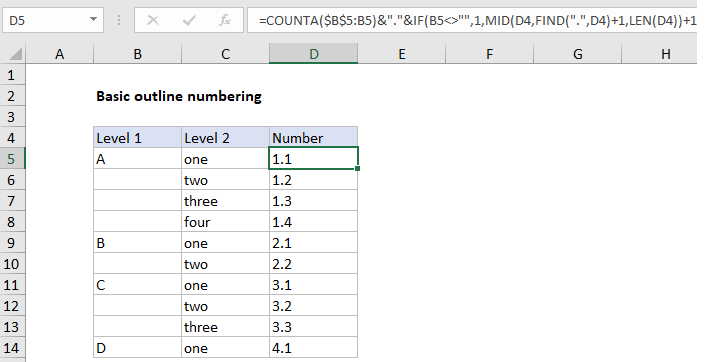
Explanation

In the example shown, the formula in D5 is:

=COUNTA($B$5:B5)&"."&IF(B5<>"",1,
MID(D4,FIND(".",D4)+1,LEN(D4))+1)

How this formula works

At the core, this formula builds a level 1 and level 2 number and concatenates the two numbers together with a period (“.”) as a separator. The result is a value like “1.1”. The “level 1” number is generated with COUNTA like this:

=COUNTA($B$5:B5)

Note the range is an expanding reference, so it will expand as it is copied down the column.

The “level 2” number is generated with this code:

IF(B5<>"",1,MID(D4,FIND(".",D4)
+1,LEN(D4))+1)

Step 1: Here, the IF function is used to check the contents of B5. If B5 is not blank, it means we have a new level 1 heading and IF returns 1. In other words, every time we have a new level 1 entry, we restart level 2 numbering at 1.

Step 2: If the B5 *is* blank we need to increment the level 2 number using the value in the cell above. This is a bit tricky, because the outline number is a text string, not a number. That means we need to extract the value with a text function before we can increment. To do this, we use the MID function to extract all text to the right of the period (“.”), which we locate with the FIND function:

MID(D4,FIND(".",D4)+1,LEN(D4))+1

Step 3:The LEN function is used as a simple way to guarantee all characters after the period are extracted. Notice we then add 1 directly to the result, which is still text. This math operation causes Excel to coerce the text to a number, so the result is an incremented number. Finally, the level 1 and level 2 numbers are concatenated together with a period (“.”) as a separator.

Post navigation

Previous Post:

How to calculate project complete percentage in Excel

Next Post:

Popularly Used Excel Functions and their examples

Leave a Reply Cancel reply

Your email address will not be published. Required fields are marked *

Learn Basic Excel

Ribbon
Workbook
Worksheets
Format Cells
Find & Select
Sort & Filter
Templates
Print
Share
Protect
Keyboard Shortcuts

Categories

  • Charts
  • Data Analysis
  • Data Validation
  • Excel Functions
    • Cube Functions
    • Database Functions
    • Date and Time Functions
    • Engineering Functions
    • Financial Functions
    • Information Functions
    • Logical Functions
    • Lookup and Reference Functions
    • Math and Trig Functions
    • Statistical Functions
    • Text Functions
    • Web Functions
  • Excel VBA
  • Excel Video Tutorials
  • Formatting
  • Grouping
  • Others

Logical Functions

  • Excel If, Nested If, And/Or Criteria Examples
  • Invoice status with nested if in Excel
  • Not Equal To ‘<>‘ operator in Excel
  • Return blank if in Excel
  • Check multiple cells are equal in Excel

Date Time

  • Basic Overtime Calculation Formula in Excel
  • How to get year from date in Excel
  • Get days, months, and years between dates in Excel
  • ISOWEEKNUM function: Description, Usage, Syntax, Examples and Explanation
  • MINUTE function: Description, Usage, Syntax, Examples and Explanation

Grouping

  • Map inputs to arbitrary values in Excel
  • If cell contains one of many things in Excel
  • Calculate conditional mode with criteria in Excel
  • Group numbers at uneven intervals in Excel
  • Group times into 3 hour buckets in Excel

General

  • AutoRecover file that was never saved in Excel
  • How to password protect excel sheet?
  • Advanced Number Formats in Excel
  • How to generate random date between two dates in Excel
  • Find, Select, Replace and Go To Special in Excel
© 2025 xlsoffice . All Right Reserved. | Teal Smiles | Abbreviations And Their Meaning