
Skip to content
Free Excel Tutorials
  • Home
  • Excel For Beginners
  • Excel Intermediate
  • Advanced Excel For Experts

Data Analysis

  • Everything about Charts in Excel
  • Data Series in Excel
  • How to calculate average last N values in a table in Excel
  • How To Perform and Interpret Regression Analysis in Excel
  • Excel Frequency Function Example

References

  • How to use Excel LOOKUP Function
  • Count unique text values with criteria
  • How to get relative column numbers in a range in Excel
  • CHOOSE function: Description, Usage, Syntax, Examples and Explanation
  • How to get first column number in range in Excel

Data Validations

  • Excel Data validation don’t exceed total
  • Data validation must not exist in list
  • Excel Data validation date in specific year
  • Excel Data validation specific characters only
  • Excel Data validation must not contain

How to check if cell contains number in Excel

by

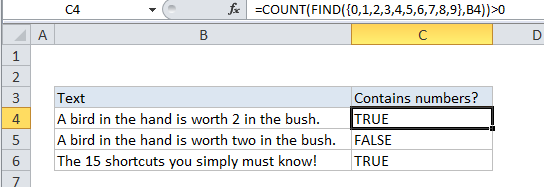
To test if a cell (or any text string) contains a number, you can use the FIND function together with the COUNT function. In the generic form of the formula (above), A1 represents the cell you are testing. The numbers to be checked (numbers between 0-9) are supplied as an array.

Formula

=COUNT(FIND({0,1,2,3,4,5,6,7,8,9},A1))>0
Explanation

In the example the formula in C4 is:

=COUNT(FIND({0,1,2,3,4,5,6,7,8,9},B4))>0

How this formula works

The FIND function returns the position of the text when it’s found in the cell, and the #VALUE! error if not.  In the example,  the cell B4 contains the number “2” in the 29th position. So, if we just used this formula:

=FIND("2",B4)

It would return the number 29 as the result. However, because we are giving the FIND function an array of items to check, it will return an array of results that looks like this:

{#VALUE!,#VALUE!,29,#VALUE!,#VALUE!,#VALUE!,#VALUE!,#VALUE!,#VALUE!,#VALUE!}

In other words, FIND checks the contents of B4 for each number and returns the result of each check as an item in the array.

After FIND returns the array, COUNT counts the items in the array. COUNT only counts numeric values, so any #VALUE! item in the array is treated as zero. COUNT will return a number greater than zero if there are any numbers in the array, and zero if not.

The last step in the formula is to compare the result the FIND and COUNT functions with zero. If there were any numbers found, the formula will return TRUE. If not, the formula will return FALSE.

If you want to do something more than just test whether a cell contains text, you can wrap the formula in an IF statement like so:

=IF(COUNT(FIND({0,1,2,3,4,5,6,7,8,9},B4))>0, "Yes", "No")

Instead of returning TRUE or FALSE, the formula above returns “Yes” if B4 contains any numbers and “No” if not.

Cell equals number?

If you only need to test if a cell equals a number, you can use the ISNUMBER function like this:

=ISNUMBER(A1)


Post navigation

Previous Post:

DECIMAL function: Description, Usage, Syntax, Examples and Explanation

Next Post:

AVERAGE function: Description, Usage, Syntax, Examples and Explanation

Leave a Reply Cancel reply

Your email address will not be published. Required fields are marked *

Learn Basic Excel

Ribbon
Workbook
Worksheets
Format Cells
Find & Select
Sort & Filter
Templates
Print
Share
Protect
Keyboard Shortcuts

Categories

  • Charts
  • Data Analysis
  • Data Validation
  • Excel Functions
    • Cube Functions
    • Database Functions
    • Date and Time Functions
    • Engineering Functions
    • Financial Functions
    • Information Functions
    • Logical Functions
    • Lookup and Reference Functions
    • Math and Trig Functions
    • Statistical Functions
    • Text Functions
    • Web Functions
  • Excel VBA
  • Excel Video Tutorials
  • Formatting
  • Grouping
  • Others

Logical Functions

  • How to use Excel NOT Function
  • AND function: Description, Usage, Syntax, Examples and Explanation
  • XOR function: Description, Usage, Syntax, Examples and Explanation
  • Not Equal To ‘<>‘ operator in Excel
  • Complete List of Excel Logical Functions, References and Examples

Date Time

  • YEAR function: Description, Usage, Syntax, Examples and Explanation
  • Sum race time splits in Excel
  • Convert text date dd/mm/yy to mm/dd/yy in Excel
  • Calculate days remaining in Excel
  • Convert decimal seconds to Excel time

Grouping

  • Group numbers at uneven intervals in Excel
  • Map text to numbers in Excel
  • Group numbers with VLOOKUP in Excel
  • Group arbitrary text values in Excel
  • Group times into 3 hour buckets in Excel

General

  • Select, Insert, Rename, Move, Delete Worksheets in Excel
  • Creating and Opening an existing file in Excel
  • Common Errors in Excel
  • 231 Keyboard Shortcut Keys In Excel
  • AutoRecover file that was never saved in Excel
© 2025 xlsoffice . All Right Reserved. | Teal Smiles | Abbreviations And Their Meaning