
Skip to content
Free Excel Tutorials
  • Home
  • Excel For Beginners
  • Excel Intermediate
  • Advanced Excel For Experts

Data Analysis

  • How To Load Analysis ToolPak in Excel
  • How to create Checklist in Excel
  • What-If Analysis: Scenarios and Goal Seek in Excel
  • Excel Pie Chart
  • How to calculate average last N values in a table in Excel

References

  • How to get relative column numbers in a range in Excel
  • Multi-criteria lookup and transpose in Excel
  • Approximate match with multiple criteria in Excel
  • How to use Excel TRANSPOSE Function
  • How to use Excel ROWS Function

Data Validations

  • Excel Data validation specific characters only
  • Excel Data validation must contain specific text
  • Excel Data validation date in specific year
  • Excel Data validation allow weekday only
  • Excel Data validation whole percentage only

VLOOKUP from another sheet in Excel

by

This tutorial shows how to calculate VLOOKUP from another sheet in Excel using the example below;

Formula

=VLOOKUP(lookup,sheet!range,column,match)
Explanation

Using VLOOKUP from another sheet is very similar to using VLOOKUP on the same sheet.

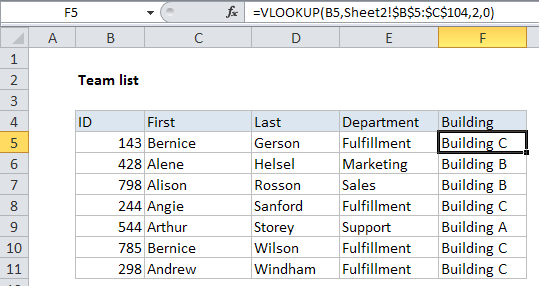
In the example shown, the formula in F5 is:

=VLOOKUP(B5,Sheet2!$B$5:$C$104,2,0)

Here, VLOOKUP pulls the correct building for each employee on Sheet2, into the table on Sheet1.

How this formula works

In this example, we have a list of employee locations like this on Sheet2:
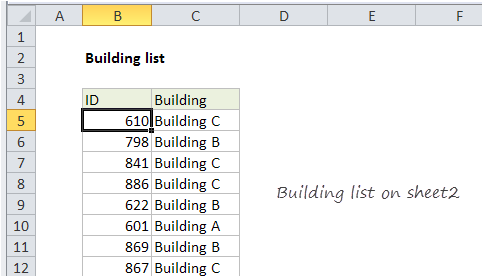
On Sheet1, we retrieve the building location for each team member using this formula:

=VLOOKUP(B5,Sheet2!$B$5:$C$104,2,0)

For lookup value, we simply use the value in column B, the employee id.

For the table array, we we use the range B54:$C$104 qualified with a sheet name:

Sheet2!$B$5:$C$104 // includes sheet name

This is the only difference from a standard VLOOKUP formula — including the sheet name simply tells VLOOKUP which sheet to use for the table lookup range.

Finally, column number is 2, since the building names appear in the second column, and VLOOKUP is set to exact match mode by including zero as the forth argument. This ensures that we get the correct building for each team member and a #N/A error if for some reason the id is not found in the location table.

Post navigation

Previous Post:

COSH function: Description, Usage, Syntax, Examples and Explanation

Next Post:

Excel Data validation require unique number

Leave a Reply Cancel reply

Your email address will not be published. Required fields are marked *

Learn Basic Excel

Ribbon
Workbook
Worksheets
Format Cells
Find & Select
Sort & Filter
Templates
Print
Share
Protect
Keyboard Shortcuts

Categories

  • Charts
  • Data Analysis
  • Data Validation
  • Excel Functions
    • Cube Functions
    • Database Functions
    • Date and Time Functions
    • Engineering Functions
    • Financial Functions
    • Information Functions
    • Logical Functions
    • Lookup and Reference Functions
    • Math and Trig Functions
    • Statistical Functions
    • Text Functions
    • Web Functions
  • Excel VBA
  • Excel Video Tutorials
  • Formatting
  • Grouping
  • Others

Logical Functions

  • Extract multiple matches into separate rows in Excel
  • XOR function: Description, Usage, Syntax, Examples and Explanation
  • How to use Excel TRUE Function
  • Check multiple cells are equal in Excel
  • How to use Excel OR Function

Date Time

  • Calculate time difference in hours as decimal value in Excel
  • Get fiscal quarter from date in Excel
  • Get project end date in Excel
  • How to Calculate Age in Excel
  • Convert decimal hours to Excel time

Grouping

  • Categorize text with keywords in Excel
  • Map inputs to arbitrary values in Excel
  • Group times into 3 hour buckets in Excel
  • Running count group by n size in Excel
  • Group arbitrary text values in Excel

General

  • Lock Cells in a Worksheet Excel
  • Excel Operators
  • Select, Insert, Rename, Move, Delete Worksheets in Excel
  • How to calculate total from percentage in Excel
  • Basic numeric sort formula in Excel
© 2026 xlsoffice . All Right Reserved. | Teal Smiles | Abbreviations And Their Meaning