
Skip to content
Free Excel Tutorials
  • Home
  • Excel For Beginners
  • Excel Intermediate
  • Advanced Excel For Experts

Data Analysis

  • Conflicting Multiple Conditional Formatting Rules in Excel
  • Get column index in Excel Table
  • How To Load Analysis ToolPak in Excel
  • How To Perform and Interpret Regression Analysis in Excel
  • What-If Analysis: Scenarios and Goal Seek in Excel

References

  • How to get address of first cell in range in Excel
  • Multi-criteria lookup and transpose in Excel
  • Extract all partial matches in Excel
  • How to use Excel FORMULATEXT function
  • How to create dynamic named range with OFFSET in Excel

Data Validations

  • Excel Data validation require unique number
  • Excel Data validation with conditional list
  • Excel Data validation specific characters only
  • Excel Data validation date in next 30 days
  • Prevent invalid data entering in specific cells

Remove text by variable position in a cell in Excel

by

To remove text from a cell when the text is at a variable position, you can use a formula based on the REPLACE function, with help from the FIND function.

Formula

=REPLACE(text,start,FIND(marker,text)+1,"")
Explanation

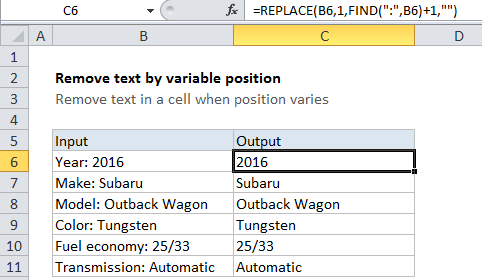
In the example shown, the formula in C6 is:

=REPLACE(B6,1,FIND(":",B6)+1,"")

How this formula works

The REPLACE function will replace text by position. You can use REPLACE to remove text by providing an empty string (“”) for the “new_text” argument.

In this case, we want to remove the labels that appear inside text. The labels vary in length, and include words like “Make”, “Model”, “Fuel economy”, and so on. Each label is followed by a colon and a space. We can use the colon as a “marker” to figure out where the label ends.

Working from the inside out, we use the FIND function to get the position of the colon in the text, then add 1 to take into account the space that follows the colon. The result (a number) is plugged into the REPLACE function for the “num_chars” argument, which represents the number of characters to replace.

The REPLACE function then replaces the text from 1 to “colon + 1” with “”. In the example shown, the solution looks like this:

=REPLACE(B6,1,FIND(":",B6)+1,"")
=REPLACE(B6,1,6,"")
=2016

Post navigation

Next Post:

Create One-dimensional and Two-dimensional Array

Leave a Reply Cancel reply

Your email address will not be published. Required fields are marked *

Learn Basic Excel

Ribbon
Workbook
Worksheets
Format Cells
Find & Select
Sort & Filter
Templates
Print
Share
Protect
Keyboard Shortcuts

Categories

  • Charts
  • Data Analysis
  • Data Validation
  • Excel Functions
    • Cube Functions
    • Database Functions
    • Date and Time Functions
    • Engineering Functions
    • Financial Functions
    • Information Functions
    • Logical Functions
    • Lookup and Reference Functions
    • Math and Trig Functions
    • Statistical Functions
    • Text Functions
    • Web Functions
  • Excel VBA
  • Excel Video Tutorials
  • Formatting
  • Grouping
  • Others

Logical Functions

  • AND function: Description, Usage, Syntax, Examples and Explanation
  • Not Equal To ‘<>‘ operator in Excel
  • Return blank if in Excel
  • How to use Excel TRUE Function
  • How to use Excel OR Function

Date Time

  • How to enter Today’s Date or Static Date and Time in Excel
  • Get days, hours, and minutes between dates in Excel
  • How to determine year is a leap year in Excel
  • Count times in a specific range in Excel
  • Get first Monday before any date in Excel

Grouping

  • Group arbitrary text values in Excel
  • If cell contains one of many things in Excel
  • Categorize text with keywords in Excel
  • Running count group by n size in Excel
  • Group numbers at uneven intervals in Excel

General

  • How to calculate percent sold in Excel
  • How to generate random number between two numbers in Excel
  • With vs Without Array Formula in Excel
  • How to calculate total from percentage in Excel
  • How to add sequential row numbers to a set of data in Excel
© 2026 xlsoffice . All Right Reserved. | Teal Smiles | Abbreviations And Their Meaning