Skip to content
Free Excel Tutorials
  • Home
  • Excel For Beginners
  • Excel Intermediate
  • Advanced Excel For Experts

Data Analysis

  • How to create running total in an Excel Table
  • How to calculate average last N values in a table in Excel
  • Managing Conditional Formatting Rules in Excel
  • Error Bars in Excel
  • How to Create Gantt Chart in Excel

References

  • How to get relative column numbers in a range in Excel
  • Approximate match with multiple criteria in Excel
  • How to calculate two-way lookup VLOOKUP in Excel Table
  • How to use Excel ROWS Function
  • Merge tables with VLOOKUP in Excel

Data Validations

  • Excel Data validation whole percentage only
  • Excel Data validation allow uppercase only
  • Prevent invalid data entering in specific cells
  • Excel Data validation date in next 30 days
  • Excel Data validation specific characters only

SKEW function: Description, Usage, Syntax, Examples and Explanation

by

What is SKEW function in Excel?

SKEW function is one of Statistical functions in Microsoft Excel that returns the skewness of a distribution. Skewness characterizes the degree of asymmetry of a distribution around its mean. Positive skewness indicates a distribution with an asymmetric tail extending toward more positive values. Negative skewness indicates a distribution with an asymmetric tail extending toward more negative values.

Syntax of SKEW function

SKEW(number1, [number2], …)

The SKEW function syntax has the following arguments:

  • Number1, number2, …    Number1 is required, subsequent numbers are optional. 1 to 255 arguments for which you want to calculate skewness. You can also use a single array or a reference to an array instead of arguments separated by commas.

Explanation of SKEW function

  • Arguments can either be numbers or names, arrays, or references that contain numbers.
  • Logical values and text representations of numbers that you type directly into the list of arguments are counted.
  • If an array or reference argument contains text, logical values, or empty cells, those values are ignored; however, cells with the value zero are included.
  • Arguments that are error values or text that cannot be translated into numbers cause errors.
  • If there are fewer than three data points, or the sample standard deviation is zero, SKEW returns the #DIV/0! error value.
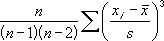
  • The equation for skewness is defined as:Equation

Example of SKEW function

Steps to follow:

1. Open a new Excel worksheet.

2. Copy data in the following table below and paste it in cell A1

Note: For formulas to show results, select them, press F2 key on your keyboard and then press Enter.

You can adjust the column widths to see all the data, if need be.

Data
3
4
5
2
3
4
5
6
4
7
Formula Description Result
=SKEW(A2:A11) Skewness of a distribution of the data set in A2:A11. 0.359543

Post navigation

Previous Post:

How to generate random date between two dates in Excel

Leave a Reply Cancel reply

Your email address will not be published. Required fields are marked *

Learn Basic Excel

Ribbon
Workbook
Worksheets
Format Cells
Find & Select
Sort & Filter
Templates
Print
Share
Protect
Keyboard Shortcuts

Categories

  • Charts
  • Data Analysis
  • Data Validation
  • Excel Functions
    • Cube Functions
    • Database Functions
    • Date and Time Functions
    • Engineering Functions
    • Financial Functions
    • Information Functions
    • Logical Functions
    • Lookup and Reference Functions
    • Math and Trig Functions
    • Statistical Functions
    • Text Functions
    • Web Functions
  • Excel VBA
  • Excel Video Tutorials
  • Formatting
  • Grouping
  • Others

Logical Functions

  • Extract multiple matches into separate rows in Excel
  • IFERROR function: Description, Usage, Syntax, Examples and Explanation
  • Check multiple cells are equal in Excel
  • How to return blank in place of #DIV/0! error in Excel
  • How to use IFS function in Excel

Date Time

  • How to calculate next scheduled event in Excel
  • Add business days to date in Excel
  • Series of dates by day
  • Add months to date in Excel
  • Get day name from date in Excel

Grouping

  • Group times into 3 hour buckets in Excel
  • Categorize text with keywords in Excel
  • Group numbers at uneven intervals in Excel
  • Group times into unequal buckets in Excel
  • How to randomly assign data to groups in Excel

General

  • AutoFit Column Width, AutoFit Row Height in Excel
  • How to choose page/paper size in Excel before Printing
  • How to calculate decrease by percentage in Excel
  • How to password protect excel sheet?
  • Creating and Opening an existing file in Excel
© 2025 xlsoffice . All Right Reserved. | Teal Smiles | Abbreviations And Their Meaning