
Skip to content
Free Excel Tutorials
  • Home
  • Excel For Beginners
  • Excel Intermediate
  • Advanced Excel For Experts

Data Analysis

  • How To Compare Two Lists in Excel
  • Move chart to a separate worksheet in Excel
  • How to Create Thermometer Chart in Excel
  • How to calculate correlation coefficient Correlation in Excel
  • How To Load Analysis ToolPak in Excel

References

  • Approximate match with multiple criteria in Excel
  • How to use Excel OFFSET function
  • Perform case-sensitive Lookup in Excel
  • Extract all partial matches in Excel
  • How to get last row in numeric data in Excel

Data Validations

  • Excel Data validation unique values only
  • Data validation must not exist in list
  • Excel Data validation date in next 30 days
  • Excel Data validation must contain specific text
  • Excel Data validation date in specific year

Two-column Lookup in Excel

by

This example teaches you how to perform a two-column lookup in Excel. See the example below. We want to look up the salary of James Clark, not James Smith, not James Anderson.

1. To join strings, use the & operator.
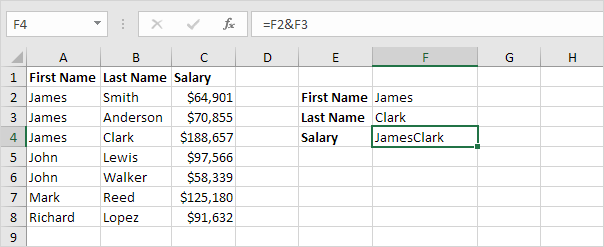
2. The MATCH function returns the position of a value in a given range. Insert the MATCH function shown below.

3. Finish by pressing CTRL + SHIFT + ENTER.
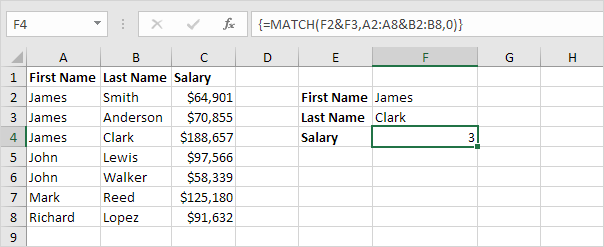
Note: The formula bar indicates that this is an array formula by enclosing it in curly braces {}. Do not type these yourself. They will disappear when you edit the formula.

Explanation: The range (array constant) A2:A8&B2:B8 is stored in Excel’s memory, not in a range. The array constant looks as follows:

{“JamesSmith”;”JamesAnderson”;”JamesClark”;”JohnLewis”;”JohnWalker”;”MarkReed”;”RichardLopez”}

This array constant is used as an argument for the MATCH function, giving a result of 3 (JamesClark found at position 3).

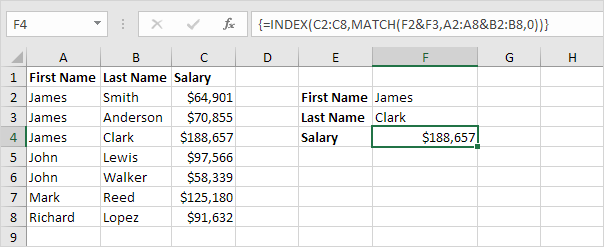
4. Use this result and the INDEX function to return the 3rd value in the range C2:C8.
Post navigation

Previous Post:

VLOOKUP without #N/A error in Excel

Next Post:

Manipulating text strings using Left, Mid, Right, Len, Substitute in Excel

Leave a Reply Cancel reply

Your email address will not be published. Required fields are marked *

Learn Basic Excel

Ribbon
Workbook
Worksheets
Format Cells
Find & Select
Sort & Filter
Templates
Print
Share
Protect
Keyboard Shortcuts

Categories

  • Charts
  • Data Analysis
  • Data Validation
  • Excel Functions
    • Cube Functions
    • Database Functions
    • Date and Time Functions
    • Engineering Functions
    • Financial Functions
    • Information Functions
    • Logical Functions
    • Lookup and Reference Functions
    • Math and Trig Functions
    • Statistical Functions
    • Text Functions
    • Web Functions
  • Excel VBA
  • Excel Video Tutorials
  • Formatting
  • Grouping
  • Others

Logical Functions

  • IFS function: Description, Usage, Syntax, Examples and Explanation
  • How to use Excel FALSE Function
  • IF, AND, OR and NOT Functions Examples in Excel
  • IF function: Description, Usage, Syntax, Examples and Explanation
  • SWITCH function example in Excel

Date Time

  • Get last working day in month in Excel
  • DATE function: Description, Usage, Syntax, Examples and Explanation
  • Add years to date in Excel
  • Convert text date dd/mm/yy to mm/dd/yy in Excel
  • Get work hours between dates in Excel

Grouping

  • Group numbers at uneven intervals in Excel
  • Group numbers with VLOOKUP in Excel
  • How to randomly assign data to groups in Excel
  • Group times into 3 hour buckets in Excel
  • Map inputs to arbitrary values in Excel

General

  • Check if multiple cells have same value in Excel
  • Select, Insert, Rename, Move, Delete Worksheets in Excel
  • How to Delete Cells, Row and Rows in Excel
  • Automatically fill series of cells in Excel using AutoFill
  • Transpose: Switch ‘Rows to Columns’ or ‘Columns to Rows’ in Excel
© 2026 xlsoffice . All Right Reserved. | Teal Smiles | Abbreviations And Their Meaning