
Skip to content
Free Excel Tutorials
  • Home
  • Excel For Beginners
  • Excel Intermediate
  • Advanced Excel For Experts

Data Analysis

  • Excel Pie Chart
  • How to Sort by Color in Excel
  • How To Insert and Customize Sparklines in Excel
  • How to conditionally sum numeric data in an Excel table using SUMIFS
  • Calculate Conditional Percentile ‘IF’ in table in Excel

References

  • How to use Excel OFFSET function
  • Lookup entire row in Excel
  • How to get relative row numbers in a range in Excel
  • How to create dynamic named range with OFFSET in Excel
  • How to use Excel LOOKUP Function

Data Validations

  • Excel Data validation no punctuation
  • Excel Data validation date in specific year
  • Excel Data validation require unique number
  • Excel Data validation exists in list
  • Excel Data validation allow weekday only

Get project midpoint in Excel

by

To calculate an approximate project midpoint date, you can use the WORKDAY function.

Note: The WORKDAY function returns a date in the future or past, based on a start date, workdays, and optional holidays. WORKDAY automatically excludes weekends, and counts only Monday through Friday as workdays.

Formula

=WORKDAY(start,days/2,holidays)
Explanation

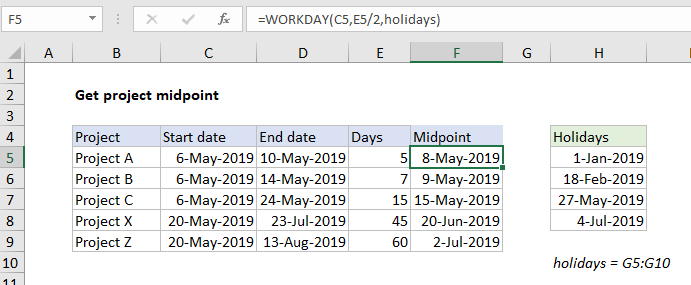
In the example shown, the formula in E5 is:

=WORKDAY(C5,E5/2,holidays)

where “holidays” is the named range G5:G10.

The WORKDAY is configured to get a project midpoint date by adding half of the days value to the start date:

=WORKDAY(C5,E5/2,holidays)

Project A is 5 workdays, so E5/2 = 2.5 days. The WORKDAY function ignores fractional values and uses only the integer portion of days, so it uses the value 2 to return a date of May 8.

Note the WORKDAY function does not count the start date as a workday.

Custom schedule

The WORKDAY function always treats Saturday and Sunday as non-working days. To get a midpoint for a project where working days are not Monday-Friday, substitute the WORKDAY.INTL function for WORKDAY. For example, to calculate a midpoint in a project where workdays are Monday-Saturday you can use a formula like this:

=WORKDAY.INTL(start,days/2,11,holidays)

There are many other ways to configure WORKDAY.INTL.

Post navigation

Previous Post:

DECIMAL function: Description, Usage, Syntax, Examples and Explanation

Next Post:

AVERAGE function: Description, Usage, Syntax, Examples and Explanation

Leave a Reply Cancel reply

Your email address will not be published. Required fields are marked *

Learn Basic Excel

Ribbon
Workbook
Worksheets
Format Cells
Find & Select
Sort & Filter
Templates
Print
Share
Protect
Keyboard Shortcuts

Categories

  • Charts
  • Data Analysis
  • Data Validation
  • Excel Functions
    • Cube Functions
    • Database Functions
    • Date and Time Functions
    • Engineering Functions
    • Financial Functions
    • Information Functions
    • Logical Functions
    • Lookup and Reference Functions
    • Math and Trig Functions
    • Statistical Functions
    • Text Functions
    • Web Functions
  • Excel VBA
  • Excel Video Tutorials
  • Formatting
  • Grouping
  • Others

Logical Functions

  • XOR function: Description, Usage, Syntax, Examples and Explanation
  • IF with boolean logic in Excel
  • OR function Examples in Excel
  • How to use Excel TRUE Function
  • How to use Excel XOR Function

Date Time

  • Add decimal hours to time in Excel
  • Convert date to month and year in Excel
  • Count birthdays by month in Excel
  • Get last day of month in Excel
  • Get work hours between dates in Excel

Grouping

  • Map inputs to arbitrary values in Excel
  • Group times into 3 hour buckets in Excel
  • If cell contains one of many things in Excel
  • Group arbitrary text values in Excel
  • Group times into unequal buckets in Excel

General

  • Subtotal by invoice number in Excel
  • Find, Trace and Correct Errors in Excel Formulas using ‘Formula Auditing’
  • How to get random value from list or table in Excel
  • Split Cell Content Using Text to Columns in Excel
  • Hide and Unhide Columns or Rows in Excel
© 2026 xlsoffice . All Right Reserved. | Teal Smiles | Abbreviations And Their Meaning