
Skip to content
Free Excel Tutorials
  • Home
  • Excel For Beginners
  • Excel Intermediate
  • Advanced Excel For Experts

Data Analysis

  • How to Use Solver Tool in Excel
  • How to sum a total in multiple Excel tables
  • How To Create Pareto Chart in Excel
  • Get column name from index in Excel Table
  • Conditional Formatting Icon Sets Examples in Excel

References

  • How to get last row in text data in Excel
  • How to reference named range different sheet in Excel
  • How to get last column number in range in Excel
  • How to get address of named range in Excel
  • CHOOSE function: Description, Usage, Syntax, Examples and Explanation

Data Validations

  • Excel Data validation number multiple 100
  • Excel Data validation allow uppercase only
  • Excel Data validation exists in list
  • Excel Data validation only dates between
  • Excel Data validation unique values only

How to show last updated date stamp in Excel

by

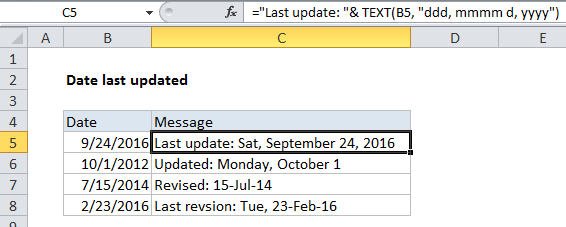
To add a date stamp in a workbook to indicate a “date last updated”, you can use the TEXT function.

Note: 

The TEXT function can apply number formatting to numbers just like Excel’s built-in cell formats for dates, currency, fractions, and so on. However, unlike Excel’s cell formatting, the TEXT function works inside a formula and returns a result that is text.

You can use TEXT to format numbers that appear inside other text strings. In this case, we concatenate the test “Last update” with the result provided by the TEXT function, which picks up a date from column B and formats it using the supplied number format.

You can embed the date in any format you like, using the codes that represent date formats (dd, mm ,yyyy, etc.)

 Formula

="Last update: "& TEXT(A1, "ddd, mmmm d, yyyy")
Last-updated-date-stamp How to show last updated date stamp in Excel

Explanation

In the example shown, the formula in C5 is:

="Last update: "& TEXT(B5, "ddd, mmmm d, yyyy")

With a named range

One convenient way to manage a “last updated” message in a large workbook is to use a named range to hold the date last updated, then refer to that named range in formulas elsewhere to display a last update message.

For example, you can name a cell something like “last_update”, and use that cell to enter the date last updated. Once you’ve defined the named range, you can use the formula below anywhere you like to display the same message:

="Updated: "& TEXT(last_update, "ddd, mmmm d, yyyy")

Whenever you change the date value in the named range, all formulas will update instantly, and all date stamps will stay in sync.

Post navigation

Previous Post:

DECIMAL function: Description, Usage, Syntax, Examples and Explanation

Next Post:

AVERAGE function: Description, Usage, Syntax, Examples and Explanation

Leave a Reply Cancel reply

Your email address will not be published. Required fields are marked *

Learn Basic Excel

Ribbon
Workbook
Worksheets
Format Cells
Find & Select
Sort & Filter
Templates
Print
Share
Protect
Keyboard Shortcuts

Categories

  • Charts
  • Data Analysis
  • Data Validation
  • Excel Functions
    • Cube Functions
    • Database Functions
    • Date and Time Functions
    • Engineering Functions
    • Financial Functions
    • Information Functions
    • Logical Functions
    • Lookup and Reference Functions
    • Math and Trig Functions
    • Statistical Functions
    • Text Functions
    • Web Functions
  • Excel VBA
  • Excel Video Tutorials
  • Formatting
  • Grouping
  • Others

Logical Functions

  • FALSE function: Description, Usage, Syntax, Examples and Explanation
  • Not Equal To ‘<>‘ operator in Excel
  • Complete List of Excel Logical Functions, References and Examples
  • NOT function: Description, Usage, Syntax, Examples and Explanation
  • How to use Excel FALSE Function

Date Time

  • Convert Excel time to decimal hours in Excel
  • Get project midpoint in Excel
  • Convert date string to date time in Excel
  • SECOND function: Description, Usage, Syntax, Examples and Explanation
  • WORKDAY.INTL function: Description, Usage, Syntax, Examples and Explanation

Grouping

  • Map inputs to arbitrary values in Excel
  • Group arbitrary text values in Excel
  • Group numbers at uneven intervals in Excel
  • Categorize text with keywords in Excel
  • Group times into unequal buckets in Excel

General

  • How to calculate percent change in Excel
  • Create dynamic workbook reference to another workbook in Excel
  • Lock Cells in a Worksheet Excel
  • Basic text sort formula in Excel
  • How to create dynamic named range with INDEX in Excel
© 2026 xlsoffice . All Right Reserved. | Teal Smiles | Abbreviations And Their Meaning