
Skip to content
Free Excel Tutorials
  • Home
  • Excel For Beginners
  • Excel Intermediate
  • Advanced Excel For Experts

Data Analysis

  • Calculate Conditional Percentile ‘IF’ in table in Excel
  • Everything about Charts in Excel
  • Create Scatter Chart in Excel
  • Understanding Pivot Tables in Excel
  • Conditional Formatting Rules in Excel

References

  • Count unique text values with criteria
  • How to use Excel ROW Function
  • How to get last row in numeric data in Excel
  • How to use Excel LOOKUP Function
  • How to use Excel ROWS Function

Data Validations

  • Prevent invalid data entering in specific cells
  • Excel Data validation number multiple 100
  • Excel Data validation don’t exceed total
  • Excel Data validation whole percentage only
  • Excel Data validation allow uppercase only

How to multiple users can work on a Workbooks at same time

by

If you share a workbook, you can work with other people on the same workbook at the same time. The workbook should be saved to a network location where other people can open it. You can keep track of the changes other people make and accept or reject those changes.

To share a workbook, execute the following steps.

1. Open a workbook.
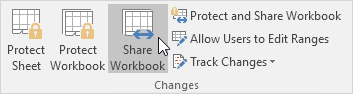
2. On the Review tab, in the Changes group, click Share Workbook.
The Share Workbook dialog box appears.

3. On the Editing tab, click the check box and click OK.
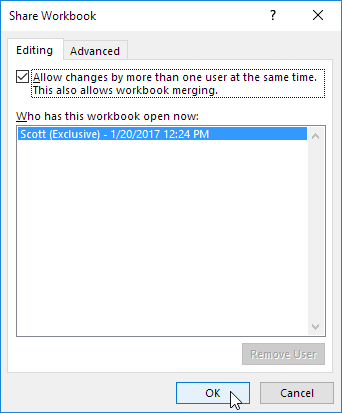
Excel saves the workbook. You can now work with other people on the same workbook at the same time. The screen above shows you who has the workbook open.

Highlight Changes

You can highlight the changes on screen other users has made.

1. On the Review tab, in the Changes group, click Track Changes.
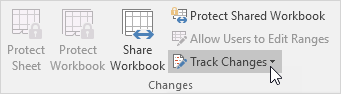
2. Click Highlight Changes.
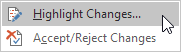
The Highlight Changes dialog box appears.

3. Click OK.
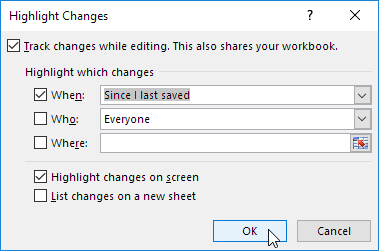
Excel highlights the changes on screen.
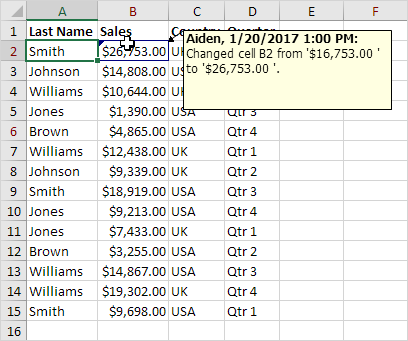
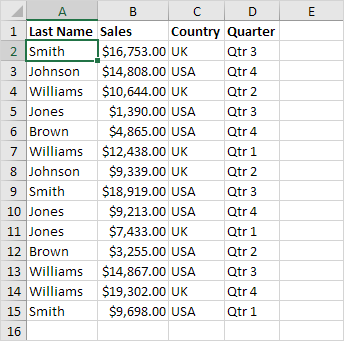
Apparently, Aiden has changed the Sales of Smith from $16,753.00 to $26,753.00.

Accept/Reject Changes

You can now accept or reject this change.

1. On the Review tab, in the Changes group, click Track Changes.

2. Click Accept/Reject Changes.

3. Click OK.
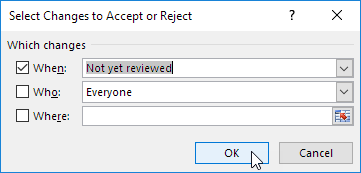
4. Click Accept to accept the change or Reject to reject the change.


Note: not all features are available in a shared workbook.

Post navigation

Previous Post:

TRUE function: Description, Usage, Syntax, Examples and Explanation

Next Post:

Excel Pie Chart

Leave a Reply Cancel reply

Your email address will not be published. Required fields are marked *

Learn Basic Excel

Ribbon
Workbook
Worksheets
Format Cells
Find & Select
Sort & Filter
Templates
Print
Share
Protect
Keyboard Shortcuts

Categories

  • Charts
  • Data Analysis
  • Data Validation
  • Excel Functions
    • Cube Functions
    • Database Functions
    • Date and Time Functions
    • Engineering Functions
    • Financial Functions
    • Information Functions
    • Logical Functions
    • Lookup and Reference Functions
    • Math and Trig Functions
    • Statistical Functions
    • Text Functions
    • Web Functions
  • Excel VBA
  • Excel Video Tutorials
  • Formatting
  • Grouping
  • Others

Logical Functions

  • IF with boolean logic in Excel
  • How to use IFS function in Excel
  • How to use Excel XOR Function
  • Not Equal To ‘<>‘ operator in Excel
  • IFS function: Description, Usage, Syntax, Examples and Explanation

Date Time

  • WORKDAY.INTL function: Description, Usage, Syntax, Examples and Explanation
  • Calculate number of hours between two times in Excel
  • How to get year from date in Excel
  • EDATE function: Description, Usage, Syntax, Examples and Explanation
  • Calculate days remaining in Excel

Grouping

  • Categorize text with keywords in Excel
  • If cell contains one of many things in Excel
  • Group arbitrary text values in Excel
  • How to randomly assign people to groups in Excel
  • Group times into unequal buckets in Excel

General

  • How to calculate project complete percentage in Excel
  • Subtotal by invoice number in Excel
  • Mark Workbook as Final in Excel
  • Sum by group in Excel
  • Customize Ribbon In Excel
© 2026 xlsoffice . All Right Reserved. | Teal Smiles | Abbreviations And Their Meaning