Skip to content
Free Excel Tutorials
  • Home
  • Excel For Beginners
  • Excel Intermediate
  • Advanced Excel For Experts

Data Analysis

  • How to Create Gantt Chart in Excel
  • Conditional Formatting Rules in Excel
  • Error Bars in Excel
  • How to calculate correlation coefficient Correlation in Excel
  • Reverse List in Excel

References

  • Merge tables with VLOOKUP in Excel
  • Last row number in range
  • Approximate match with multiple criteria in Excel
  • Find Closest Match in Excel Using INDEX, MATCH, ABS and MIN functions
  • Excel Advanced Lookup using Index and Match Functions

Data Validations

  • Excel Data validation must begin with
  • Excel Data validation date in specific year
  • How To Create Drop-down List in Excel
  • Prevent invalid data entering in specific cells
  • Excel Data validation only dates between

FORECAST function: Description, Usage, Syntax, Examples and Explanation

by

What is FORECAST function in Excel?

FORECAST function is one of Statistical functions in Microsoft Excel that calculates, or predicts, a future value by using existing values. The predicted value is a y-value for a given x-value. The known values are existing x-values and y-values, and the new value is predicted by using linear regression. You can use this function to predict future sales, inventory requirements, or consumer trends.

Syntax of FORECAST function

FORECAST(x, known_y’s, known_x’s)

The FORECAST function syntax has the following arguments:

  • X    Required. The data point for which you want to predict a value.
  • Known_y’s    Required. The dependent array or range of data.
  • Known_x’s    Required. The independent array or range of data.

FORECAST formula explanation

  • If x is nonnumeric, FORECAST returns the #VALUE! error value.
  • If known_y’s and known_x’s are empty or contain a different number of data points, FORECAST returns the #N/A error value.
  • If the variance of known_x’s equals zero, then FORECAST returns the #DIV/0! error value.
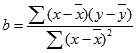
  • The equation for FORECAST is a+bx, where:Equationand:

    Equation

    and where x and y are the sample means AVERAGE(known_x’s) and AVERAGE(known y’s).

Example of FORECAST function

Steps to follow:

1. Open a new Excel worksheet.

2. Copy data in the following table below and paste it in cell A1

Note: For formulas to show results, select them, press F2 key on your keyboard and then press Enter.

You can adjust the column widths to see all the data, if need be.

Known Y Known X
6 20
7 28
9 31
15 38
21 40
Formula Description Result
=FORECAST(30,A2:A6,B2:B6) Predicts a value for y given an x value of 30 10.607253

Post navigation

Previous Post:

How to generate random date between two dates in Excel

Leave a Reply Cancel reply

Your email address will not be published. Required fields are marked *

Learn Basic Excel

Ribbon
Workbook
Worksheets
Format Cells
Find & Select
Sort & Filter
Templates
Print
Share
Protect
Keyboard Shortcuts

Categories

  • Charts
  • Data Analysis
  • Data Validation
  • Excel Functions
    • Cube Functions
    • Database Functions
    • Date and Time Functions
    • Engineering Functions
    • Financial Functions
    • Information Functions
    • Logical Functions
    • Lookup and Reference Functions
    • Math and Trig Functions
    • Statistical Functions
    • Text Functions
    • Web Functions
  • Excel VBA
  • Excel Video Tutorials
  • Formatting
  • Grouping
  • Others

Logical Functions

  • How to use Excel XOR Function
  • How to use IFS function in Excel
  • NOT function: Description, Usage, Syntax, Examples and Explanation
  • Nested IF function example in Excel
  • IF with wildcards in Excel

Date Time

  • Count day of week between dates in Excel
  • Pad week numbers with zeros in Excel
  • TODAY function: Description, Usage, Syntax, Examples and Explanation
  • Convert date to Julian format in Excel
  • Get work hours between dates in Excel

Grouping

  • How to randomly assign people to groups in Excel
  • Group numbers at uneven intervals in Excel
  • Group times into 3 hour buckets in Excel
  • Calculate conditional mode with criteria in Excel
  • How to randomly assign data to groups in Excel

General

  • How to Delete Cells, Row and Rows in Excel
  • Find, Select, Replace and Go To Special in Excel
  • How to generate random number weighted probability in Excel
  • Transpose: Switch ‘Rows to Columns’ or ‘Columns to Rows’ in Excel
  • How to calculate percent sold in Excel
© 2026 xlsoffice . All Right Reserved. | Teal Smiles | Abbreviations And Their Meaning