
Skip to content
Free Excel Tutorials
  • Home
  • Excel For Beginners
  • Excel Intermediate
  • Advanced Excel For Experts

Data Analysis

  • How To Compare Two Lists in Excel
  • How to create Checklist in Excel
  • Chart Axes in Excel
  • How To Load Analysis ToolPak in Excel
  • How to calculate correlation coefficient Correlation in Excel

References

  • How to retrieve first match between two ranges in Excel
  • How to get last row in mixed data with blanks in Excel
  • To count total rows in a range in Excel
  • How to get address of last cell in range in Excel
  • How to create dynamic named range with OFFSET in Excel

Data Validations

  • Excel Data validation must not contain
  • How To Create Drop-down List in Excel
  • Excel Data validation unique values only
  • Excel Data validation require unique number
  • Excel Data validation number multiple 100

Sum if date is between in Excel

by

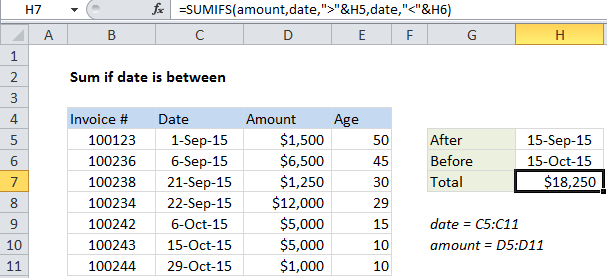
This tutorial shows how to Sum if date is between in Excel using the example below;

Formula

=SUMIFS(amount,start_date,">"&A1,end_date,"<"&B1)
Explanation

To sum values that are between two dates, you can use the SUMIFS function.

In the example shown, cell H5 contains this formula:

=SUMIFS(amount,date,">"&H5,date,"<"&H6)

This formula sums the amounts in column D when a date in column C is between a date in H5 and a date in H6. In the example, H5 contains Sept 15, 2015 and H6 contains Oct 15, 2015.

How the formula works

The SUMIFS function supports Excel’s logical operators (i.e. “=”,”>”,”>=”, etc.), and multiple criteria.

To match dates between two values, we need to use two criteria. SUMIFs require that each criteria be entered as a criteria/range pair:

">"&H5,date // criteria 1
"<"&H6,date // criteria 2

Note that we need to enclose the logical operators in double quotes (“”) then join with cell references using an ampersand (&).

Take care to use greater than or equal to (“>=”) and less than or equal to (“<=”) if you want to include (match) the start or end date as well as the dates in between.

Post navigation

Previous Post:

How to use Excel CHOOSE Function

Next Post:

Customize Ribbon In Excel

Leave a Reply Cancel reply

Your email address will not be published. Required fields are marked *

Learn Basic Excel

Ribbon
Workbook
Worksheets
Format Cells
Find & Select
Sort & Filter
Templates
Print
Share
Protect
Keyboard Shortcuts

Categories

  • Charts
  • Data Analysis
  • Data Validation
  • Excel Functions
    • Cube Functions
    • Database Functions
    • Date and Time Functions
    • Engineering Functions
    • Financial Functions
    • Information Functions
    • Logical Functions
    • Lookup and Reference Functions
    • Math and Trig Functions
    • Statistical Functions
    • Text Functions
    • Web Functions
  • Excel VBA
  • Excel Video Tutorials
  • Formatting
  • Grouping
  • Others

Logical Functions

  • SWITCH function: Description, Usage, Syntax, Examples and Explanation
  • How to use Excel NOT Function
  • Check multiple cells are equal in Excel
  • IF with boolean logic in Excel
  • XOR function: Description, Usage, Syntax, Examples and Explanation

Date Time

  • How to calculate workdays per month in Excel
  • Display the current date and time in Excel
  • How to calculate quarter from date in Excel
  • Create date range from two dates in Excel
  • SECOND function: Description, Usage, Syntax, Examples and Explanation

Grouping

  • Calculate conditional mode with criteria in Excel
  • Categorize text with keywords in Excel
  • Running count group by n size in Excel
  • Group times into unequal buckets in Excel
  • If cell contains one of many things in Excel

General

  • Lock Cells in a Worksheet Excel
  • How to Insert Cells, Row and Rows in Excel
  • Subtotal invoices by age in Excel
  • Basic error trapping example in Excel
  • Count cells that do not contain errors in Excel
© 2025 xlsoffice . All Right Reserved. | Teal Smiles | Abbreviations And Their Meaning