
Skip to content
Free Excel Tutorials
  • Home
  • Excel For Beginners
  • Excel Intermediate
  • Advanced Excel For Experts

Data Analysis

  • Managing Conditional Formatting Rules in Excel
  • What-If Analysis: Scenarios and Goal Seek in Excel
  • How to count table columns in Excel
  • Understanding Anova in Excel
  • Excel Frequency Function Example

References

  • Approximate match with multiple criteria in Excel
  • How to use Excel INDIRECT Function
  • Complete List of Excel Lookup and Reference Functions, References and Examples
  • How to get last row in numeric data in Excel
  • How to get address of last cell in range in Excel

Data Validations

  • Excel Data validation number multiple 100
  • Excel Data validation allow weekday only
  • Excel Data validation allow uppercase only
  • Excel Data validation date in specific year
  • Data validation must not exist in list

If this AND that in Excel

by

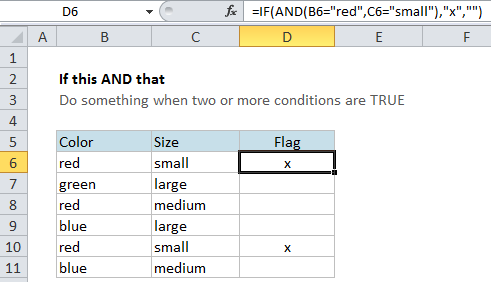
This tutorial shows how to calculate If this AND that in Excel using the example below;

Formula

=IF(AND(A1="this",B1="that"),"x","")
Explanation

If you want to do something specific when two or more conditions are TRUE, you can use the IF function in combination with the AND function to evaluate conditions with a test, then take one action if the result is TRUE, and (optionally) do something else if the result of the test is FALSE.

If color = red AND size = small

In the example shown, we simply want to “mark” or “flag” records where the color is red AND the size is small. In other words, we want to check cells in column B for the color “red” AND check cells in column C to see if the size is “small”. Then, if both conditions are TRUE, we can take a specific action.

In D6, the formula were using is this:

=IF(AND(B6="red",C6="small"),"x","")

In this formula, the logical test is this bit:

AND(B6="red",C6="small")

This snippet will return TRUE only if the value in B6 is “red” AND the value in C6 is “small”. If either condition isn’t true, the test will return FALSE.

Next, we need to take an action when the result of the test is TRUE. In this case, we do that by adding an “x” to column D. If the test is FALSE,  we simply add an empty string (“”). This causes an “x” to appear in column D when both conditions are true and nothing to display if not.

Note: if we didn’t add the empty string when FALSE, the formula would actually display FALSE whenever the color is not red.

Testing the same cell

In the example above we are checking two different cells, but there nothing that prevents you from running two tests on the same cell. For example, let’s say you want to check values in column A and then do something when a value at least 100 but less than 200.  In that case you could use this code for the logical test:

=AND(A1>=100,A1<200)

Post navigation

Previous Post:

COSH function: Description, Usage, Syntax, Examples and Explanation

Next Post:

Excel Data validation require unique number

Leave a Reply Cancel reply

Your email address will not be published. Required fields are marked *

Learn Basic Excel

Ribbon
Workbook
Worksheets
Format Cells
Find & Select
Sort & Filter
Templates
Print
Share
Protect
Keyboard Shortcuts

Categories

  • Charts
  • Data Analysis
  • Data Validation
  • Excel Functions
    • Cube Functions
    • Database Functions
    • Date and Time Functions
    • Engineering Functions
    • Financial Functions
    • Information Functions
    • Logical Functions
    • Lookup and Reference Functions
    • Math and Trig Functions
    • Statistical Functions
    • Text Functions
    • Web Functions
  • Excel VBA
  • Excel Video Tutorials
  • Formatting
  • Grouping
  • Others

Logical Functions

  • IFERROR function: Description, Usage, Syntax, Examples and Explanation
  • SWITCH function: Description, Usage, Syntax, Examples and Explanation
  • Check multiple cells are equal in Excel
  • How to use Excel OR Function
  • Nested IF function example in Excel

Date Time

  • EDATE function: Description, Usage, Syntax, Examples and Explanation
  • Count birthdays by month in Excel
  • Get fiscal quarter from date in Excel
  • SECOND function: Description, Usage, Syntax, Examples and Explanation
  • Series of dates by day

Grouping

  • Map inputs to arbitrary values in Excel
  • Group numbers with VLOOKUP in Excel
  • Group times into unequal buckets in Excel
  • How to randomly assign data to groups in Excel
  • Group times into 3 hour buckets in Excel

General

  • Common Errors in Excel
  • Cell References: Relative, Absolute and Mixed Referencing Examples
  • With vs Without Array Formula in Excel
  • Using Existing Templates in Excel
  • Lock Cells in a Worksheet Excel
© 2026 xlsoffice . All Right Reserved. | Teal Smiles | Abbreviations And Their Meaning