
Skip to content
Free Excel Tutorials
  • Home
  • Excel For Beginners
  • Excel Intermediate
  • Advanced Excel For Experts

Data Analysis

  • Conditional Formatting Color Scales Examples in Excel
  • Error Bars in Excel
  • How To Load Analysis ToolPak in Excel
  • Randomize/ Shuffle List in Excel
  • How to do a t-Test in Excel?

References

  • How to get address of named range in Excel
  • Find Closest Match in Excel Using INDEX, MATCH, ABS and MIN functions
  • Create hyperlink with VLOOKUP in Excel
  • How to use Excel COLUMN Function
  • Extract all partial matches in Excel

Data Validations

  • Excel Data validation whole percentage only
  • How To Create Drop-down List in Excel
  • Excel Data validation number multiple 100
  • Excel Data validation date in next 30 days
  • Excel Data validation with conditional list

Normalize text by removing punctuations, extra spaces and more in Excel

by

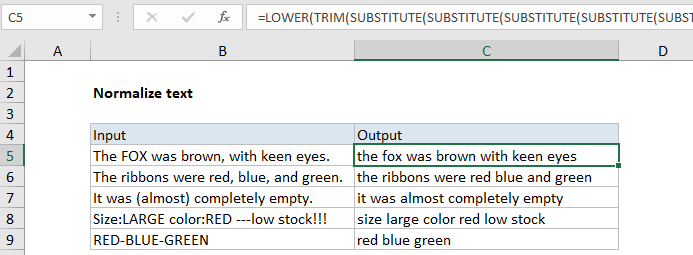
To remove some of the natural complexity of text (strip punctuation, normalize case, remove extra spaces) you can use a formula based on the SUBSTITUTE function, with help from the TRIM and LOWER functions.

Instance

There may be times when you need to remove some of the variability of text before other processing.

Case Study

One example is when you want to count specific words inside larger text strings. Because Excel doesn’t provide support for regular expressions, you can’t construct precise matches. For example, if you want to count how many times the word “fox” appears in a cell, you will end up counting “foxes”. You can look for “fox ” (with a space) but that will fail with “fox,” or “fox.” One workaround is to simplify the text first with a formula in a helper column, then run counts on the simplified version. The example on this page shows one way to do this.

Formula

=LOWER(TRIM(SUBSTITUTE(SUBSTITUTE(SUBSTITUTE(SUBSTITUTE(SUBSTITUTE(SUBSTITUTE
(SUBSTITUTE(SUBSTITUTE(A1,"("," "),")"," "),"-"," "),":"," "),";"," "),"!"," "),
","," "),"."," ")))
Explanation

How this formula works

The formula shown in this example uses a series of nested SUBSTITUTE functions to strip out parentheses, hyphens, colons, semi-colons, exclamation marks, commas, and periods. The process runs from the inside out, with each SUBSTITUTE replacing one character with a single space, then handing off to the next SUBSTITUTE. The inner most SUBSTITUTE removes the left parentheses, and the result is handed to the next SUBSTITUTE, which removes the right parentheses, and so on.

In the version below, line breaks have been added for readability, and to make it easier to edit replacements. Excel does not care about line breaks in formulas, so you can use the formula as-is.

=
LOWER(
TRIM(
SUBSTITUTE(
SUBSTITUTE(
SUBSTITUTE(
SUBSTITUTE(
SUBSTITUTE(
SUBSTITUTE(
SUBSTITUTE(
SUBSTITUTE(
A1,
"("," "),
")"," "),
"-"," "),
":"," "),
";"," "),
"!"," "),
","," "),
"."," ")))

After all substitutions are complete, the result is run through TRIM to normalize spaces, then the LOWER function to force all text to lowercase.

Note: You’ll need to adjust the actual replacements to suit your data.

Adding a leading and trailing space

In some cases you may want to add a space character to the start and end of the cleaned text. For example, if you want to count words precisely, you may want to look for the word surrounded by spaces (i.e. search for ” fox “, ” map “) to avoid false matches. To add a leading and trailing space, just concatenate a space (” “) to the start and end:

=" "&formula&" "

Where “formula” is the longer formula above.

Post navigation

Next Post:

Create One-dimensional and Two-dimensional Array

Leave a Reply Cancel reply

Your email address will not be published. Required fields are marked *

Learn Basic Excel

Ribbon
Workbook
Worksheets
Format Cells
Find & Select
Sort & Filter
Templates
Print
Share
Protect
Keyboard Shortcuts

Categories

  • Charts
  • Data Analysis
  • Data Validation
  • Excel Functions
    • Cube Functions
    • Database Functions
    • Date and Time Functions
    • Engineering Functions
    • Financial Functions
    • Information Functions
    • Logical Functions
    • Lookup and Reference Functions
    • Math and Trig Functions
    • Statistical Functions
    • Text Functions
    • Web Functions
  • Excel VBA
  • Excel Video Tutorials
  • Formatting
  • Grouping
  • Others

Logical Functions

  • IF with wildcards in Excel
  • How to return blank in place of #DIV/0! error in Excel
  • How to use IFS function in Excel
  • SWITCH function: Description, Usage, Syntax, Examples and Explanation
  • IFNA function: Description, Usage, Syntax, Examples and Explanation

Date Time

  • Get week number from date in Excel
  • Get fiscal year from date in Excel
  • Check If Two Dates are same month in Excel
  • Add decimal hours to time in Excel
  • DAYS function: Description, Usage, Syntax, Examples and Explanation

Grouping

  • How to randomly assign data to groups in Excel
  • If cell contains one of many things in Excel
  • Group times into unequal buckets in Excel
  • Group arbitrary text values in Excel
  • Map text to numbers in Excel

General

  • Check if multiple cells have same value in Excel
  • Subtotal by color in Excel
  • How to count total number of cells in a rectangular range in Excel
  • How to calculate decrease by percentage in Excel
  • Count cells that do not contain errors in Excel
© 2025 xlsoffice . All Right Reserved. | Teal Smiles | Abbreviations And Their Meaning